What is sexual coercion? Sexual coercion is getting someone to a sexual yes without their real consent, through threats, punishment, force, pressure or other negative forms of power. Sexual coercion is always a form of sexual violence, even when nobody was physically violent.
“Does what happened to me count as trauma? Does it count as coercion, or as sexual violence?” These are the questions a lot of women ask me. And it makes sense that they would, because the definitions aren’t consistent, and society has a way of minimizing what women go through.
The law doesn’t define it consistently. Researchers don’t define it consistently, and the public doesn’t have a clear definition of it either. So a lot of people end up arguing about what it is, and women end up feeling like they’re being dramatic, or they’re being too much, or they’re exaggerating. And then they don’t get the help they need.
Here’s why it matters. Coercive sex is a form of sexual violence, and like all forms of sexual violence, it can leave scars behind that are really hard to heal (Garrido-Macías et al., 2026, p. 2).
This is part 1 of a two-part series. Here I cover what sexual coercion is and how it relates to consent. Part 2, Types of Sexual Coercion, walks through the four types I teach, with real examples, and the kind of help that actually helps. A heads-up before we go further: this post talks about sexual coercion and sexual violence, with real examples of what they can look like. If that’s a lot for you right now, it’s okay to come back to it later.
What Is Coercion?
To understand sexual coercion, you first need to understand what coercion is. The American Psychological Association defines coercion as “the process of attempting to influence another person through the use of threats, punishment, force, direct pressure, and other negative forms of power” (American Psychological Association, 2018).
Once you understand coercion, it’s a lot easier to understand sexual coercion, because it’s the use of coercion for a sexual outcome. One research definition puts it this way: sexual coercion is “the act of being physically, psychologically, financially or otherwise forced or tricked into engaging in sexual activity” (Sathyanarayana Rao et al., 2013, p. 211).
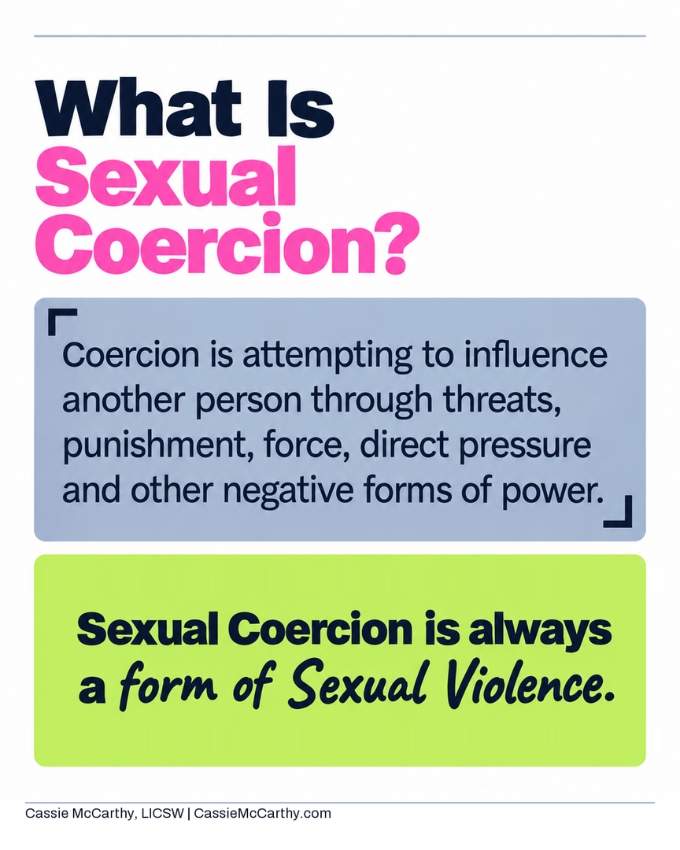
Sexual coercion is always a form of sexual violence.
Is Sexual Coercion a Form of Sexual Violence?
Yes. Sexual coercion is a type of sexual violence. Research defines sexual violence as any sexual act obtained from a person without their consent (Mou, 2026, p. 475). I want you to think about it as a spectrum. Under the umbrella of sexual violence, we have things like:
- sexual coercion
- sexual harassment
- sexual assault
- sexual abuse
- rape
Anyone can be impacted by sexual violence. Men, women, trans people, children, adults, the elderly. It doesn’t discriminate, though most victims are women (Mou, 2026, p. 475).
But one of the problems we face is that everyone defines each of those words slightly differently, and that leaves people really confused about how to understand what happened to them. Words like “rape” and “sexual assault” mean different things to different people, and that leads to underreporting (Mou, 2026, p. 476). People don’t know how to talk about it, and so it goes underreported, undertreated and under-helped.
Clinical Reality:
Oftentimes people don’t count sexual coercion as sexual violence, because they think no overt act of violence happened.
But not all violence is overt.
People often don’t see coerced sex as sexual violence when nobody was physically violent (Anyadike-Danes et al., 2024, pp. 239–240). There are a lot of nuanced types of violence that aren’t physical at all: emotional violence, financial violence. So of course sexual violence doesn’t need to be overtly physical for it to have violent outcomes.
If you’ve lived with this kind of pressure in a relationship, I wrote about it in Does A Manipulative Relationship Count As Trauma If You Were Never Hit?
Why I Ask About Behaviors, Not Labels
That’s why I don’t rely on the label of what happened. I use behavioral descriptions of what happened, so it can make better sense to the person I’m talking with.
It’s hard for someone to say yes to “Were you sexually coerced?” But if I ask, “Have you ever had a sexual act that you felt like you couldn’t say no to?” that’s a little different. Now we’re talking about the behaviors that were happening, and she can identify them more easily, because we’re giving her a consistent way to identify it. Research finds the same thing: questions that use behaviorally specific language find more of it (Mou, 2026, p. 476).
If we use words that aren’t consistently defined, it’s really hard for people to see themselves in them. These descriptions help you name what happened. They’re not a diagnosis, and they’re not a legal definition, which varies by state. If something felt wrong and it isn’t named here, it still matters. And if you’ve ever asked whether what happened to you was “bad enough,” What Counts as Trauma? walks through what the diagnosis actually says.
That’s why I built a checklist that names behaviors, not labels. Does This Count As Trauma? A Checklist for Women Who Wonder if What They Went Through Was “Bad Enough” to Be Called Trauma goes through all different kinds of trauma exposure, sexual coercion included, in behavioral terms, so you can recognize what you went through and get better help for it. Clinicians use it to help assess what a client has gone through, too. You can find it here whenever you’re ready.
What Is Consent? (And What It Isn't)
There are a lot of misconceptions about what consent is and what coercion is, so let’s clarify them. Going along with sex isn’t consent to sex. And just because you didn’t say no or fight it off doesn’t mean you were okay with what happened.
Consent is a very specific thing that most people don’t understand, and yet consent is woven into all kinds of definitions around sexual violence.
For example, the FBI uses the word consent in its definition of rape. The FBI’s old definition of rape was in use for more than 80 years (Federal Bureau of Investigation, 2012, p. 3):
“the carnal knowledge of a female forcibly and against her will.”
In 2013, the FBI began collecting data under a revised definition of rape:
“penetration, no matter how slight, of the vagina or anus with any body part or object, or oral penetration by a sex organ of another person, without the consent of the victim” (Federal Bureau of Investigation, 2014).
Most people don’t realize this is now the FBI’s definition of rape. It’s very clear and very blunt about what rape is. It says “without the consent of the victim.” And then it doesn’t define consent.
Fortunately, we can look at what some states have done, as well as what the research says. California has a pretty good standard. In 2014, it created an affirmative consent standard for its colleges (California Senate Bill 967, 2014). It’s a college standard, not criminal law, and it says:
- consent must be affirmative, conscious and voluntary, so a person has to opt into it
- silence, or a lack of protest, is not consent
- consent can be taken back at any time
The FBI’s change and California’s standard shifted the conversation from force to consent (Mou, 2026, p. 476). But more needs to be done.
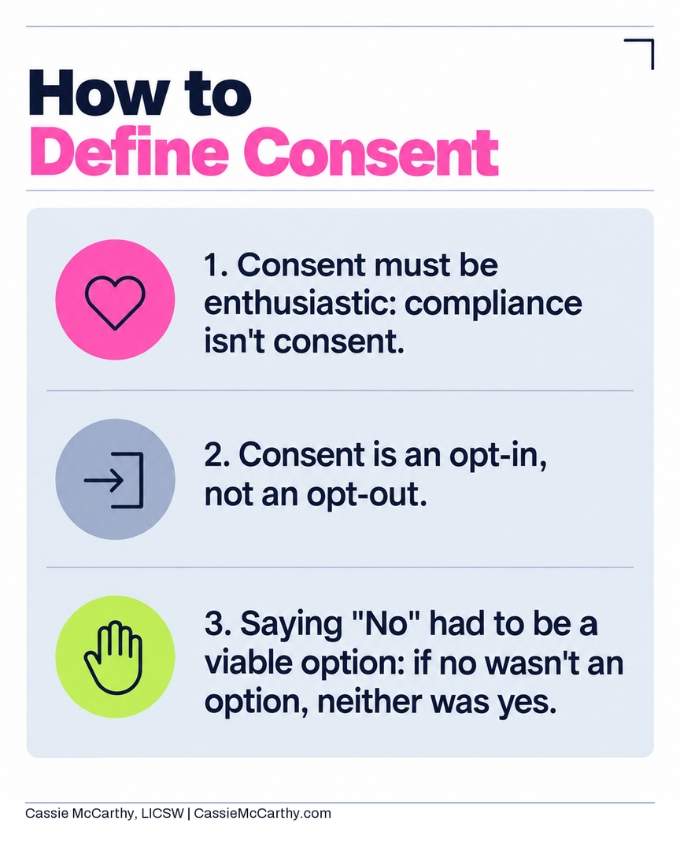
My 3 Rules of Consent
I’ve taken that standard, plus a lot of the research, and created my own three rules of what defines consent. I use them with my clients and when I teach other people about consent. They’re my clinical standard, not a legal definition.
1. Consent must be enthusiastic
It can’t be a lukewarm yes, or “I guess, fine,” or “maybe.” The person has to show that they want this, not that they’re going along with it. Going along with something when your choices are constrained isn’t consensual sex. It’s compliance. Compliance isn’t consent.
Having to be convinced, or someone trying to put you in the mood, isn’t enthusiasm either. That’s coercion. They’re trying to get you to do something you weren’t already interested in.
I often say to my clients that a healthy sex drive is a little narcissistic. It’s the feeling of, “Ooh, you’re into me. That makes me more into you.” And then two people kind of ping-pong off each other. We all want our partner to be into us. That’s okay, that’s normal. So if a partner doesn’t care whether you’re enthusiastic, that’s weird about them.
“If a partner doesn’t care whether you’re enthusiastic, that’s weird about them.”
2. Consent is an opt-in, not an opt-out
You have to be asked if you want to do something. Nobody can assume you’re going along with something until you say no. You have to be asked. You have to opt in.
“Well, she didn’t say no.”
“I didn’t walk away.”
“I didn’t stop it.”
None of those things imply consent. They might mean you froze, but they don’t mean you consented. Consent requires that you be asked, that you be invited to make the decision. So if you were incapacitated, or you froze and it kept happening, or for whatever reason you weren’t given a choice in the matter, you couldn’t have consented.
3. No had to be a viable option
If no wasn’t an option, neither was yes. For yes to exist, no must also exist. So:
- children can’t say no to adults, so children can’t consent to sexual acts with adults
- employees can’t say no to their employers, which is why an employee can’t consent to sex with her employer
- if you were too drunk or too inebriated to understand what was going on, saying no wasn’t an option, so saying yes wasn’t either
If you couldn’t say no, you couldn’t consent. I walk through all three rules, with examples, on YouTube.
Freezing Is Not Consent
One of the things that gets really confusing for people is when they froze. They say things like, “But I didn’t do anything. I just sat there. I did nothing.” And they go into a shame spiral of blaming themselves. But saying no isn’t a requirement for it to be coercion.
A lot of people, when they feel pressured, when they feel a lack of options, when they feel like escape without penalty isn’t possible, freeze. In the research, we call this tonic immobility. What that basically means is that a cascade of chemicals left your brain and entered your body and told you, “Fighting back or resisting right now could cause a worse outcome.” Sometimes saying no or fighting increases the risk of violence or of another negative outcome.
So in that moment, your brain made a snap decision: freeze, or fight and get the negative outcome plus the sexual assault anyway. Your brain froze. You couldn’t say no, because you were chemically silenced. You couldn’t fight back, because you were chemically immobilized. That’s why it wasn’t your fault for not saying no. And if you weren’t enthusiastically engaged, you weren’t saying yes either.
If freezing is part of your story, Fawn Response: Why Fawning Isn’t Part of Fight, Flight, or Freeze explains more about how those responses work.
Freezing is common. In one study of 298 women seen at an emergency clinic in Stockholm within a month of a sexual assault, 70% reported significant freezing during it, and the women who froze were more likely to develop PTSD afterward (Möller et al., 2017).
Clinical Reality:
Freezing is your brain trying to keep you from a worse outcome.
Not acting and not speaking is not consent.
Consent Is What Divides Wanted Sex From Sexual Violence
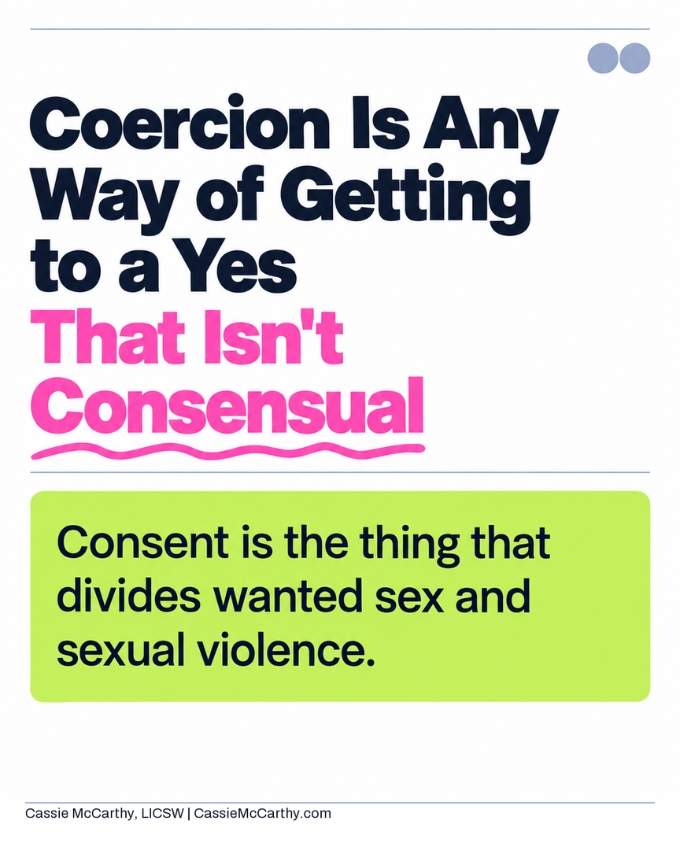
Consent is the thing that divides wanted sex and sexual violence.
In the research, “a key element that separates consensual sex and sexual violence is whether the sexual act is obtained without consent” (Mou, 2026, p. 485). Consent is the thing that divides wanted sex from sexual violence. Once consent is out of the equation, we’re in the realm of sexual violence, and coercion is any way of getting to a yes that isn’t consensual.
This matters in therapy, too. When therapists struggle to diagnose PTSD, sometimes it’s because they’re struggling with the definition of exposure, which is actual or threatened death, serious injury or sexual violence. And they might be struggling to define sexual violence. But we have it in the research: any sexual act without consent is a form of sexual violence (Mou, 2026, p. 475). The lack of consent is woven through the definition of sexual violence, and it’s woven through the definition of coercion.
So what were you taught consent is? Was enthusiasm part of it? For a lot of women, it wasn’t, and that’s part of why coercion is so hard to name.
Coercion also comes in a lot of varieties. Perpetrators have self-reported the tactics they use, and we can break them down into four main categories. That’s part 2 of this series.
If You're Exploring Your Own Story →
If you’ve been wondering whether what happened to you counts as trauma, my free checklist can help you sort it out.
If You're A Clinician Supporting This Work →
If you’re a clinician reading this, this is the work I teach in my CE course, When Consent Is Compromised. It gives you a clear plan for assessing, pacing and treating sexual coercion, with skills you can use with your clients right away.
If you are a current therapy client of mine, please reach out before purchasing.
Frequently Asked Questions
Click or tap any question to see the answer. Click or tap again to close.
What Is Sexual Coercion?
Sexual coercion is the use of coercion for a sexual outcome: getting someone to a sexual yes through threats, punishment, force, pressure or other negative forms of power, without their real consent. It is always a form of sexual violence, even when nobody was physically violent.
Is Going Along With Sex the Same as Consent?
No. Going along with sex when your choices feel constrained is compliance, not consent. Consent is enthusiastic, it’s something you’re asked to opt into, and it only exists when saying no was a real option.
Does It Count as Coercion If I Froze and Didn't Say No?
Yes, it can. Saying no isn’t a requirement for it to be coercion. Freezing, which researchers call tonic immobility, is a common response when you feel pressured or trapped. Not saying no is not a yes, and freezing was never your fault.
What Is the Difference Between Sexual Coercion and Sexual Assault?
Both live under the umbrella of sexual violence, along with sexual harassment, sexual abuse and rape. People define these words differently, which is why it helps to ask about what happened, the behaviors, rather than which label fits.
If This Topic Resonates With You, You May Also Find These Articles Helpful
References:
American Psychological Association. (2018). Coercion. In APA dictionary of psychology. https://dictionary.apa.org/coercion
Anyadike-Danes, N., Reynolds, M., Armour, C., & Lagdon, S. (2024). Defining and measuring sexual consent within the context of university students’ unwanted and nonconsensual sexual experiences: A systematic literature review. Trauma, Violence, & Abuse, 25(1), 231–245. https://doi.org/10.1177/15248380221147558
California Senate Bill 967, Student safety: sexual assault, Chapter 748 (2014). Cal. Educ. Code § 67386. http://www.leginfo.ca.gov/pub/13-14/bill/sen/sb_0951-1000/sb_967_bill_20140928_chaptered.html
Federal Bureau of Investigation. (2012). UCR program quarterly (Newsletter 12-2). https://le.fbi.gov/file-repository/ucr-newsletter-may-2012.pdf
Federal Bureau of Investigation. (2014). Crime in the United States, 2013: Rape. U.S. Department of Justice. https://ucr.fbi.gov/crime-in-the-u.s/2013/crime-in-the-u.s.-2013/violent-crime/rape
Garrido-Macías, M., Gómez-Pulido, E. A., Sáez, G., & Expósito, F. (2026). The quiet sacrifice: How sexual coercion experiences shape women’s sexual wellbeing. Anales de Psicología, 42(1), Article e10. https://doi.org/10.6018/analesps.654451
Möller, A., Söndergaard, H. P., & Helström, L. (2017). Tonic immobility during sexual assault: A common reaction predicting post-traumatic stress disorder and severe depression. Acta Obstetricia et Gynecologica Scandinavica, 96(8), 932–938. https://doi.org/10.1111/aogs.13174
Mou, N. L. (2026). Men’s sexual violence against women: A systematic review of self-reported measures of perpetration. Trauma, Violence, & Abuse, 27(2), 475–489. https://doi.org/10.1177/15248380251316907
Sathyanarayana Rao, T. S., Nagpal, M., & Andrade, C. (2013). Sexual coercion: Time to rise to the challenge. Indian Journal of Psychiatry, 55(3), 211–213. https://doi.org/10.4103/0019-5545.117125
🛟 If you're not safe right now, that matters more than anything else in this post.
Use a device he doesn't have access to.
- RAINN National Sexual Assault Hotline: 800-656-HOPE (4673), free and confidential, 24/7
- Text START to 88788 (National Domestic Violence Hotline)
- Chat 24/7 at thehotline.org and press "Chat"
- Call 1-800-799-7233 (SAFE)
If you're in crisis, call or text 988.
Advocates are available in more than 290 languages through an interpreter.

Cassie McCarthy is a trauma therapist who has practiced since 2008, helping women heal from the kind of pain that rarely gets named for what it is. She is rostered in Cognitive Processing Therapy (CPT), is an AASECT Certified Sex Therapist (CST), and practices by telehealth in Massachusetts, Vermont, Virginia, Illinois, and Florida. If you're in one of those states and want to explore working together, you can reach out to schedule a consult.