What counts as trauma, according to the diagnostic manual therapists use in the US, is exposure to actual or threatened death, serious injury, or sexual violence. The examples it gives were never meant to be the full list; the manual says in its own words that its lists are not limited to those examples (American Psychiatric Association, 2022). So the way I read it, whether something counts as trauma comes down to what it did to you, not how bad it looked from the outside.
What gets to count as trauma, and who gets to decide? I’ve seen that question come up over and over: on email listservs, in therapist Facebook groups, in peer consultation.
A therapist asks if a client’s history is bad enough to be trauma. The most recent version I saw: the client moved a lot as a kid. She went through some bullying. None of it was physical. And now, as an adult, she really struggles, and she shows all the other signs of PTSD.
If trained therapists can’t figure out what counts as trauma, how is anyone in the general public ever going to figure out what they went through and give it a name?
Was It "Bad Enough" to Count as Trauma?
This isn’t a question about whether she went through hardship, or whether her pain is real. It’s a question about whether what she went through meets what therapists call Criterion A of PTSD: the definition of exposure to trauma. You have to meet it before a therapist goes forward with the rest of the PTSD assessment.
We recognize it was hard. We recognize it was painful. But is it bad enough to be trauma? That question isn’t one therapist’s mistake. It’s a pattern, and it’s a big part of why trauma gets missed.
I hear clients say it all the time:
“Other people have it worse.”
“It was never physical.”
“Am I just being dramatic?”
I wrote more about that comparison in Does It Count As Trauma If Others Have Been Through “Worse”?
This isn’t a question about whether she went through hardship, or whether her pain is real. It’s a question about whether what she went through meets what therapists call Criterion A of PTSD: the definition of exposure to trauma. You have to meet it before a therapist goes forward with the rest of the PTSD assessment.
We recognize it was hard. We recognize it was painful. But is it bad enough to be trauma? That question isn’t one therapist’s mistake. It’s a pattern, and it’s a big part of why trauma gets missed.
What Counts as Trauma, According to the DSM
In the US, the definition of trauma comes from the Diagnostic and Statistical Manual of Mental Disorders, the DSM. It’s a big honking book, the therapist’s encyclopedia of mental health conditions. This part is my read of it, so I’ll show you the text it rests on.
The DSM says exposure means one of three kinds of harm:
- death, actual or threatened
- serious injury
- sexual violence
It also names four ways of being exposed: it happened to you, you saw it happen, you learned it happened to someone close to you, or your work put you in the details of it over and over, the way it can for police officers and first responders (American Psychiatric Association, 2022). That part is a real gate, and I’m not arguing with it.
But a lot of people stop reading there. After the numbered lists, the manual gives examples of traumatic events, and then it says, in its own words, that the list is not limited to those examples (American Psychiatric Association, 2022). The examples were never the boundary.
Clinical Reality:
The DSM’s examples are examples.
The narrowness most people run into isn’t in the book. It’s in how the field decided to read the book.
The manual goes further. It says the disorder may be especially severe or long-lasting when the stressor is interpersonal and intentional (American Psychiatric Association, 2022, p. 305). Someone did it, and they meant to. The manual doesn’t grudgingly let that kind of harm in. It names it as the kind that lasts.
What Criterion A Means by Threat, Death, Serious Injury, and Sexual Violence
Threat
The definition says real or threatened. But what’s threatening to me might not be threatening to you.
If I’m in an abusive relationship, I know my partner’s dog whistles: the look, the comment, the things he trained me to recognize. I know I’m being threatened. You might not, because threat is contextual.
So here’s how I assess threat. Did you go into fight, flight, or freeze? If you did, your brain read what was happening as a threat and activated the system that exists to keep us alive. That is real or threatened.
Freeze is the one people dismiss, and it’s not the mild one. The shutdown kind of freeze, what researchers call tonic immobility, happens when escape feels impossible and fight or flight are no longer an option (Dokkedahl et al., 2022, p. 2).
Stalking is a clear example. It’s terrifying because it’s the threat of a threat: the constant what if. Research has found that stalking is significantly associated with PTSD, even though it doesn’t meet the manual’s exposure criterion (Dokkedahl et al., 2022, p. 2).
Death
Death isn’t just are you alive or not. It’s your ability to survive. So we’re talking about housing, finances, citizenship status, even your kids. If your partner threatens your citizenship status, or your boss threatens your job, those are threats to your livelihood, which means threats to your life.
Serious injury
The manual names serious injury but doesn’t define serious. So who’s to say serious emotional or psychological injury isn’t serious injury? If something changed the way you see yourself, other people, or the world, or rewired how you think and act and move, it was injurious.
That’s how we actually measure serious: not by the input, but by the consequences. If the output was big, the input was big enough.
|
Measuring the event |
Measuring what it did |
|
“Was anyone physically hurt?” |
“Did it change how you see yourself, others, or the world?” |
|
“Was it a single, dramatic moment?” |
“Did it rewire how your body reacts?” |
|
“Would a bystander call it dangerous?” |
“Did your body read it as a threat?” |
|
“Is it on the checklist?” |
“Does it affect your work, family, or relationships?” |
|
“How does it compare to what others went through?” |
“Has your life changed because of it?” |

Sexual violence
The manual’s examples of sexual violence reach “other unwanted sexual experiences not involving contact,” and it even names coercion (American Psychiatric Association, 2022, p. 305). Coercion. Manipulation. Feeling like no wasn’t an option. These can all be sources of trauma.
But the manual gives examples, not definitions. It never says where the line sits for something like “other unwanted sexual contact” (American Psychiatric Association, 2022, p. 305). And if you’re thinking “But it wasn’t violent,” the way I read public health’s definition, violence is measured by what it does, and psychological harm counts.
Why the Definition of Trauma Got So Narrow
If the DSM left these things open, where did all the rigidity come from?
Trauma was first discovered in the 1800s, in women who were being sexually abused, and that research got suppressed. When PTSD became a diagnosis in 1980, it came out of the controversy after the Vietnam War (Dohrenwend, 2010). It was designed around veterans coming home, so it became male-centered and war-centered.
It was also unusual. Unlike most mental health diagnoses, PTSD names its cause: a traumatic event (Dohrenwend, 2010). So people became fixated on what counts as the cause.
Researchers narrow on purpose
When researchers study something, they want narrow samples, because that helps them understand their data. That’s good science. So in the early years of trauma therapy research, a lot of people were excluded from studies.
The problem is what happens next. Those entry rules get read by everyone else as the definition of trauma, when all they ever were was the requirements to get into one study.
Meanwhile, the clients coming to therapists were never coming in with just one clear event. They come in with interpersonal trauma, nuanced trauma, harm from people they thought would keep them safe. When the research doesn’t look like their clients, some therapists stop following it, even though cognitive processing therapy, EMDR, and prolonged exposure have been shown to be highly effective across a wide range of people and types of trauma.
And the research is catching up. I’ve read plenty of research linking psychological abuse, bullying, divorce, and job loss to PTSD symptoms (Dokkedahl et al., 2022; Mooren & van Minnen, 2014; Dohrenwend, 2010).
The loop this creates
Here’s what I think is happening. If psychological harm isn’t counted as exposure, it doesn’t get studied as a cause of trauma. If it doesn’t get studied, there’s never a body of evidence to argue it should count. And round it goes.
Where it has been studied, the findings are hard to ignore. Research on psychological violence in relationships found it plays a vital role in the development of PTSD (Dokkedahl et al., 2022). Those threats “can be very subtle and sometimes unspoken, just presented with a small change in voice or posture, which is not necessarily identifiable by a bystander” (Dokkedahl et al., 2022, p. 6).
Clients say it to me all the time:
“I just wish he’d hit me, so I’d have a good enough reason to leave.”
🛟 If you're not safe right now, that matters more than anything else in this post.
Use a device he doesn't have access to.
- Text START to 88788 (National Domestic Violence Hotline)
- Chat 24/7 at thehotline.org and press "Chat"
- Call 1-800-799-7233
If you're in crisis, call or text 988.
Why Trauma Checklists Like the LEC-5 Miss Emotional Abuse
One of the most common assessment tools is the Life Events Checklist, the LEC-5. It asks about 17 events, and almost all of them are a single, visible thing that happened on a particular day: natural disaster, fire or explosion, transportation accident, physical assault, assault with a weapon, sexual assault, combat (Weathers et al., 2013).
There are only two items where years of psychological harm could go. One is captivity, and its examples are being kidnapped, abducted, held hostage, or a prisoner of war (Weathers et al., 2013). A woman who couldn’t leave her relationship reads that and says no. The other is severe human suffering, which comes with no examples at all.
By the time someone reaches those questions, she has already compared her pain to everything above them. “Oh no, I don’t have it bad like that. Other people have it way worse.” We set her up for that answer.
The Adverse Childhood Experiences questionnaire, the ACEs, does a much better job of capturing nuanced harm in childhood. But calling it adverse minimizes what those experiences can do to a person. Adverse is not the same word as trauma (California Surgeon General’s Clinical Advisory Committee, 2022).
“What was the worst thing?” is the wrong question
The next tools usually ask something like what’s the worst thing you ever went through? But the worst thing isn’t always the thing that caused the PTSD. Sometimes the worst thing is just confirmation of what she already knew: “Yeah, life was hard.”
And the manual already answered this. It says that if a person can’t identify a worst example, it is appropriate to consider the entire exposure as meeting the exposure criterion. It also describes trauma as a series of events by the same person over time, with assault by an intimate partner as its example (American Psychiatric Association, 2022, p. 306). The forms still ask for one worst event.
This isn’t any one client; the details are changed, and I’ve heard versions of it many times. A girl grows up with a parent whose rage is completely unpredictable. Nobody ever hits anybody, but nobody ever knows what’s coming. And the thing that actually did the damage isn’t any of that. It’s the day she came home from school and the hoodie she wore every single day had been bagged up for donation.
It was hers. It was worth nothing to anyone else. And it was aimed at her.
“The worst thing you went through isn’t always the thing that’s still running your nervous system.”
So instead of asking what the worst thing was, I ask two questions.
Is there something painful you went through that you think about when you don’t want to be thinking about it?
Is there something painful you went through that you try your absolute best not to think about?
The issue isn’t diagnosing PTSD. The issue is what gets counted as exposure. And because exposure usually comes from self-report, it depends on what someone has been taught trauma looks like.
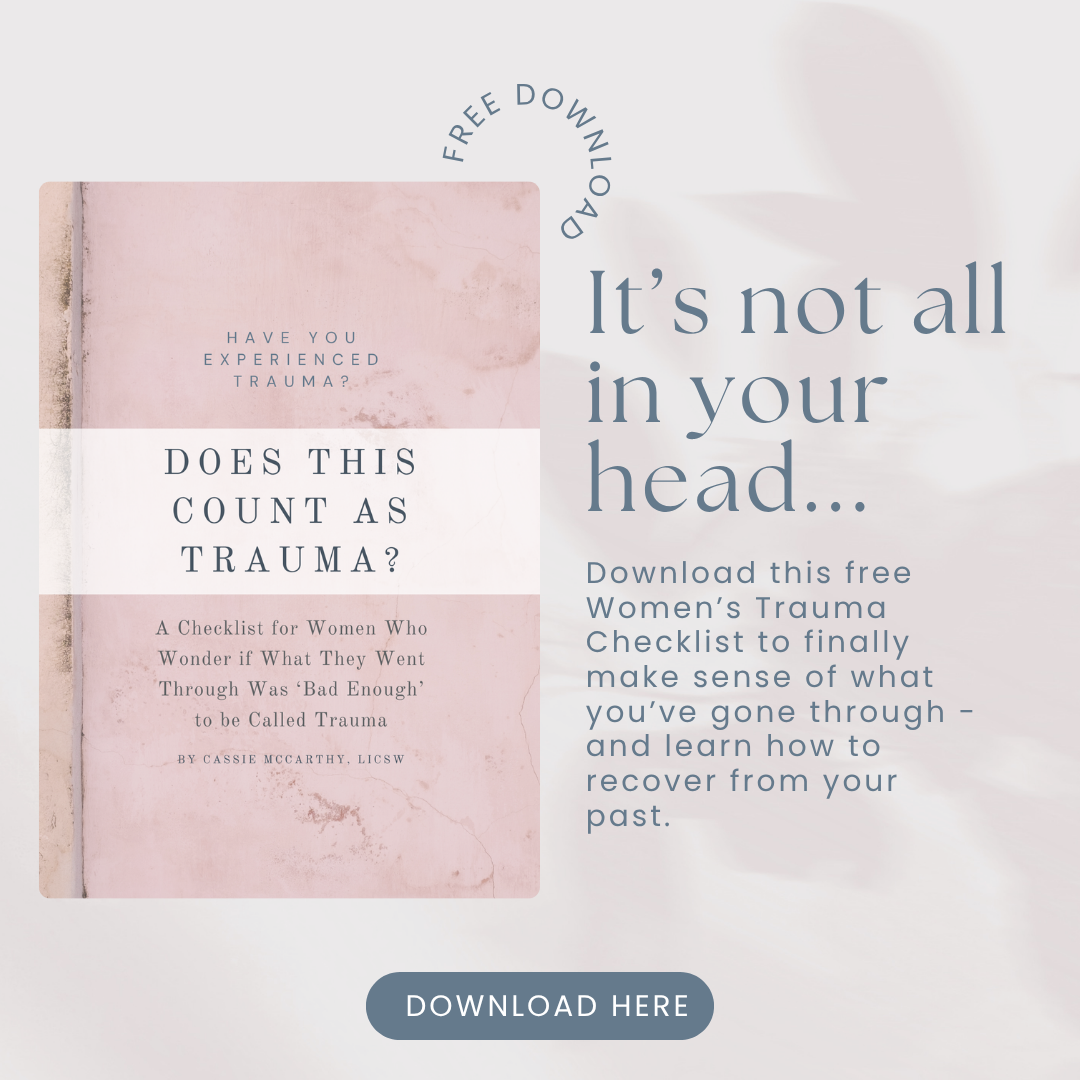
If something in this post is landing for you, that reaction is information, not a verdict. It’s also the gap I built my checklist for. Does This Count As Trauma? A Checklist for Women Who Wonder if What They Went Through Was “Bad Enough” to Be Called Trauma covers the kinds of harm standard checklists leave out, like emotional and psychological abuse, childhood adversity, and violations of trust. You can find it here whenever you’re ready.
Does Trauma Exposure Mean You Have PTSD?
No. Exposure to trauma does not equal PTSD. Exposure means we have to assess for PTSD. It doesn’t mean you have it.
In my experience, something like 70% of exposures naturally heal. That changes by the type of exposure, but on average, each time you experience exposure, you’re probably going to heal. The problem is that when the die keeps getting rolled, your odds keep changing.
The rest of the diagnosis is about what happened afterward: intrusive memories, avoidance, changes in how you think and feel, and changes in how alert your body stays (American Psychiatric Association, 2022).
Clinical Reality:
Screening someone in for exposure isn’t over-diagnosing.
It’s the start of an assessment: for PTSD, and for depression, substance use, anxiety, and everything else that travels with trauma.
The answer to the therapist's question
So what would I say to the therapist who asked, does this count as trauma? They moved a lot as a kid.
I’d say: doesn’t housing instability threaten a kid’s sense of survival? Don’t kids absolutely need predictability and consistency?
I go deeper into this in Does A Tough Childhood Count As Trauma If Nothing “Big” Happened?
And the bullying? You’re asking a small child to spend up to 40 hours a week around people who exclude her, leave her out, and make her the target of their anger. In one lab study, being socially excluded produced tonic immobility, the shutdown freeze response (Mooren & van Minnen, 2014). Freeze is a threat response. Bullying can be incredibly injurious, even if it was never physical.
Is she worth assessing? Yes. And honestly, the manual’s gate may not let her in: the 2022 revision says bullying counts only where there’s a credible threat of serious harm (American Psychiatric Association, 2022, p. 305). That’s the problem. Not her.
If she doesn’t clear that gate and her symptoms look exactly like PTSD, the manual says she gets an adjustment disorder instead (American Psychiatric Association, 2022, p. 312). Same symptoms, different label: the one built for ordinary life stress. That changes what treatment she’s offered and what anyone takes seriously.
The therapist who asked that question and the woman who can’t name her own worst event are the same problem from two directions. They’re both standing at a gate the field can’t describe.
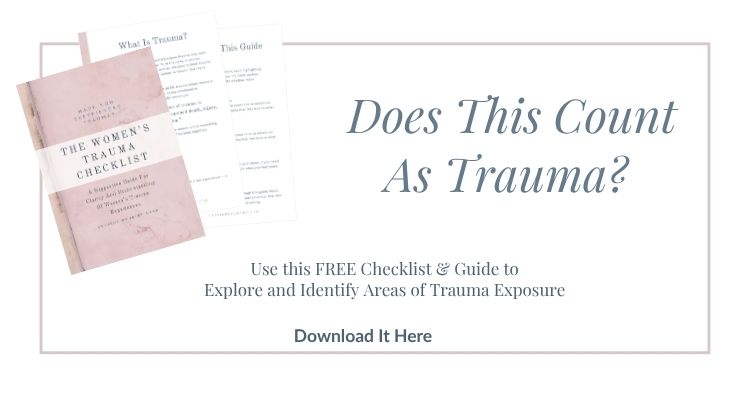
If You're Exploring Your Own Story →
If you’re still wondering “Okay, but does mine count?” you don’t have to work that out alone or keep second-guessing it. My free checklist walks through the kinds of harm women go through that often get minimized, with real examples under each one. In a few quiet minutes, you’ll have language for what happened and something concrete you can bring to a therapist if you choose to.
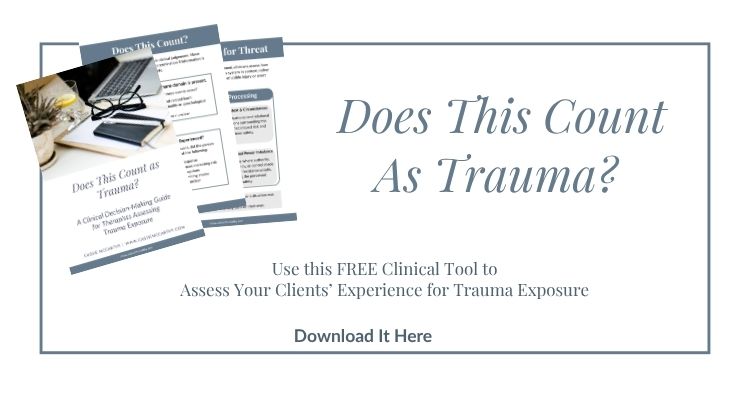
If You're A Clinician Supporting This Work →
If you’ve ever sat with a client’s history and wondered whether it meets Criterion A, my Clinical Decision-Making Guide walks you through how to assess exposure step by step: the decision tree, how to document it, and where it leads on differential diagnosis.
Frequently Asked Questions
Click or tap any question to see the answer. Click or tap again to close.
What Counts as Trauma for PTSD?
The DSM defines trauma exposure as actual or threatened death, serious injury, or sexual violence that happened to you, that you witnessed, that happened to someone close to you, or that your work repeatedly exposed you to. The manual says its examples are not a complete list, so many experiences that don’t look dramatic from the outside can still count.
Does Emotional Abuse Count as Trauma?
It can. The DSM doesn’t list emotional harm as its own category, but research shows psychological violence in relationships plays a real role in developing PTSD, and violence can be measured by the harm it does, including psychological harm. Whether it meets the exposure criterion depends on the threat involved and what it did to you, which is why a proper assessment matters.
Can Bullying Cause PTSD?
Bullying can produce real trauma symptoms, even when it was never physical. In a lab study, social exclusion produced a freeze response, and the current manual says bullying can count as exposure where there’s a credible threat of serious harm. A trauma-focused assessment looks at what the bullying did to you, not only what it looked like.
If I Experienced Trauma, Does That Mean I Have PTSD?
No. Exposure to trauma is the reason to get assessed, not a diagnosis. PTSD also requires specific symptoms afterward, such as intrusive memories, avoidance, changes in how you think and feel, and changes in how alert your body stays. Exposure can also open the door to assessing depression, anxiety, and substance use.
If This Topic Resonates With You, You May Also Find These Articles Helpful
References:
American Psychiatric Association. (2022). Diagnostic and statistical manual of mental disorders (5th ed., text rev.). https://doi.org/10.1176/appi.books.9780890425787
California Surgeon General’s Clinical Advisory Committee. (2022). Adverse childhood experience questionnaire for adults (rev. 7.26.22) [Measurement instrument]. ACEs Aware, California Department of Health Care Services. https://www.acesaware.org/learn-about-screening/screening-tools/
Dohrenwend, B. P. (2010). Toward a typology of high-risk major stressful events and situations in posttraumatic stress disorder and related psychopathology. Psychological Injury and Law, 3(2), 89–99. https://doi.org/10.1007/s12207-010-9072-1
Dokkedahl, S. B., Vang, M. L., & Elklit, A. (2022). Does tonic immobility mediate the effects of psychological violence on PTSD and complex PTSD? European Journal of Trauma & Dissociation, 6(4), Article 100297. https://doi.org/10.1016/j.ejtd.2022.100297
Mooren, N., & van Minnen, A. (2014). Feeling psychologically restrained: The effect of social exclusion on tonic immobility. European Journal of Psychotraumatology, 5(1), Article 22928. https://doi.org/10.3402/ejpt.v5.22928
Weathers, F. W., Blake, D. D., Schnurr, P. P., Kaloupek, D. G., Marx, B. P., & Keane, T. M. (2013). The Life Events Checklist for DSM-5 (LEC-5) – Standard [Measurement instrument]. National Center for PTSD. https://www.ptsd.va.gov/professional/assessment/te-measures/life_events_checklist.asp
🛟 Crisis resources
-
- Text START to 88788 (National Domestic Violence Hotline)
- Chat 24/7 at thehotline.org and press “Chat”
- Call 1-800-799-7233 (SAFE)
- Deaf/HoH: videophone 855-812-1001 or IM “DeafHotline” (ASL, 24/7)
- In crisis: call or text 988
Advocates are available in more than 290 languages through an interpreter.

Cassie McCarthy is a trauma therapist who has practiced since 2008, helping women heal from the kind of pain that rarely gets named for what it is. She is rostered in Cognitive Processing Therapy (CPT), is an AASECT Certified Sex Therapist (CST), and practices by telehealth in Massachusetts, Vermont, Virginia, Illinois, and Florida. If you're in one of those states and want to explore working together, you can reach out to schedule a consult.