CPTSD vs PTSD: what’s the difference? PTSD is a learned fear response. CPTSD is that same learned fear response, plus damage to how you manage your emotions, how you see yourself, and how you connect with other people. In the US, both are diagnosed as PTSD, because the DSM grew to cover what other countries call complex PTSD.
To understand CPTSD, you have to first understand the history of PTSD as a diagnosis and how it even came about. Then you can see how CPTSD grew out of it, and why the term causes so much confusion today. This is part 2 of a three-part series. Part 1, What Is CPTSD?, covers what CPTSD means and its symptoms, and part 3, Is There a Cure for CPTSD?, covers what helps people recover.
Where the Study of Trauma Began: Women's Trauma
We’ve known for millennia that trauma can affect a person. We’ve seen it in all kinds of literature throughout the years. But in modern medicine, we really became aware of it in the late 1800s, in France.
In a very elite French hospital, doctors were seeing women with strange paralysis of their arms and legs that wasn’t linked to anything neurological. They had all kinds of physical problems with no neurological explanation. Sigmund Freud, who trained there, did something few physicians had done before: he sat down with these women, got to know them, and talked with them.
And when he started studying these women, he found a common thread. All of these women were describing very similar things: someone in their life had been sexually abusing them. Freud proposed that this abuse led to all kinds of serious physical and emotional outcomes, and he wrote a paper called The Aetiology of Hysteria.
Hysteria is a very gendered term. It means “of the womb,” and it carries the idea of women being erratic and irrational. But back then, that was the term he had. And what he was describing was the effect of prolonged childhood sexual abuse on a person’s physical and emotional health.
People were outraged. The French elite said, how dare you go into our hospital, where our wealthy daughters are being treated, and accuse us of sexually abusing them? They threatened his funding, and he took the paper back.
Clinical Reality:
The first time medicine studied trauma, it was women’s trauma: prolonged, interpersonal, sexual.
And that research got suppressed and ignored.
How PTSD Became a Diagnosis in 1980
Jump ahead 30 or 40 years, and veterans were coming home from World War I with what was then called shell shock. That became our first understanding of war-related trauma in modern medicine, but no one really knew what to do with it, and it fell by the wayside.
Then in the 1970s, Vietnam veterans were coming home and really struggling. At the same time, the women’s liberation movement was growing. These two things came together to bring the question of what PTSD is back to the surface. PTSD entered the DSM in 1980, out of shell shock, “Vietnam syndrome” and “battered women’s syndrome” (Billings & Nicholls, 2025, p. 2).
But what got attention, credibility and research money was male-centered trauma. Partly that’s because the US Army really wanted to figure out how to get those men back into battle. So it poured resources into rehabilitating them, and when resources are poured in, research gets done.
The only diagnosis that names its cause
PTSD entered the DSM as the first diagnosis ever to have its cause noted in the diagnosis, and that made it different (Billings & Nicholls, 2025, p. 2). To be diagnosed with PTSD, all the way back to its beginning, you had to have gone through a traumatic stressor.
For all the other mental health diagnoses, we don’t actually know what causes them. We have good hypotheses, but we can’t say for certain. PTSD was different. We knew that X happened and you developed Y. It’s not automatic that anyone who goes through it will develop PTSD, but for that person, we know why.
So all the attention started to focus on the trauma event itself. In the field, we call it Criterion A, the event that caused everything else. I wrote about it in What Counts as Trauma? What the DSM Actually Says About Criterion A.
Why Women's PTSD Was Missed
Then the diagnosis and its symptoms took the shape of how the people in that research showed their symptoms. If all the research is done on veterans, and their trauma is often war-related, impersonal, more of an environmental threat, their symptoms will look more impersonal and more about the environment.
What happened was that the way women experience trauma wasn’t fully represented or understood.
Women’s trauma is often interpersonal. “Someone I trusted, someone I thought I was safe with, is the person who hurt me.” That will mess with your brain. It changes how you trust your own judgment of people and how you understand other people. It affects your relationships. It affects you in a very different way, and so the symptoms sometimes show up differently.
More on this in Why Women’s PTSD Looks Different.
Back in the 1980s, the DSM’s PTSD didn’t really cover shame, guilt or self-destruction, the way we now understand PTSD to affect people. And all through the 80s and early 90s, that was the tool people were assessed and diagnosed with.
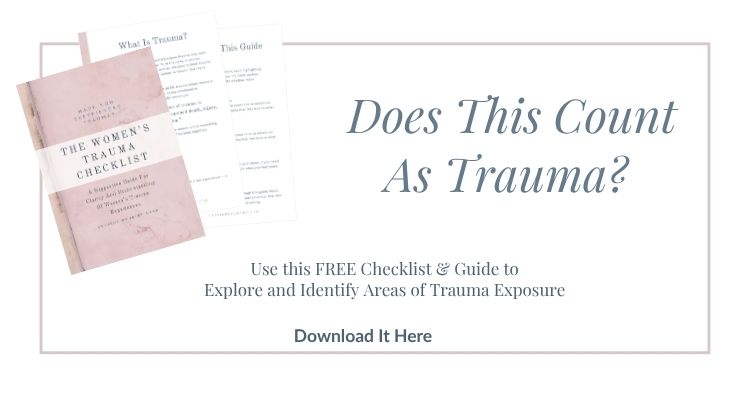
If you’ve ever held what happened to you up against that picture of trauma, one big event, a battlefield, and decided yours doesn’t count, that’s the gap I built my checklist for. Does This Count As Trauma? A Checklist for Women Who Wonder if What They Went Through Was “Bad Enough” to Be Called Trauma covers the kinds of harm standard checklists leave out, like emotional and psychological abuse, childhood adversity, and violations of trust. You can find it here whenever you’re ready.
Judith Herman and Complex PTSD
Then came a brilliant woman named Judith Herman, one of the pioneers of traumatology and trauma therapy. She wrote a wonderful book called Trauma and Recovery, and she was the cornerstone of looking at these interpersonal kinds of trauma. In 1992, she proposed the idea of complex PTSD (Herman, 1992; Billings & Nicholls, 2025, p. 2). CPTSD was the name for what PTSD missed.
At the time, she talked about it in the context of interpersonal trauma, childhood trauma, prolonged trauma, inescapable trauma. So people started associating CPTSD with the type of trauma you went through. She talked about the way it affected people too, but the concept got attached to what happened to you.
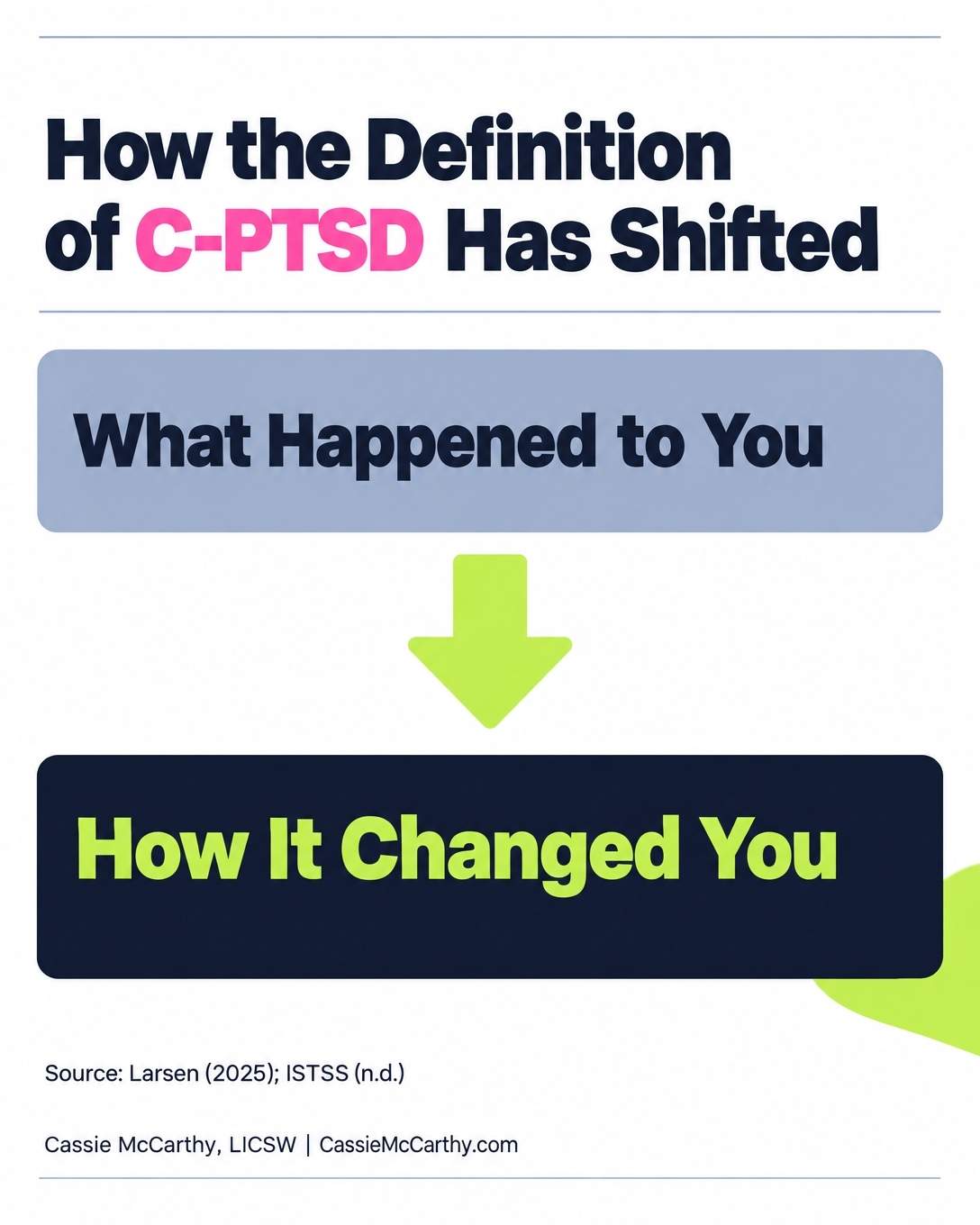
“People mixed up cause with outcome, and that mix-up is what sends people to the wrong treatment.”
Why the US Has No CPTSD Diagnosis
In 2013, the DSM moved into its fifth edition and looked at PTSD again. What it said was, essentially: we’re not going to call it complex PTSD. We’re going to expand the symptoms to cover what trauma looks like in these other ways, and we’re going to call it all PTSD.
The DSM-5’s PTSD now includes more of the symptoms traditionally thought of as part of CPTSD (Larsen, 2025, p. 2). Part of the reason is that clinicians asked for it, and it made PTSD a spectrum of severity, with CPTSD at the more severe end (Larsen, 2025, p. 2).
So in the US, it’s all PTSD: interpersonal or impersonal, prolonged or one-time exposure, whether or not it changes how you see yourself or how you regulate your emotions. It’s all under the umbrella of PTSD.
In 2018, the World Health Organization made complex PTSD its own diagnosis (Billings & Nicholls, 2025, p. 2).
| Year | What happened |
| 1980 | PTSD enters the US manual, the DSM, as the first diagnosis that names its cause |
| 1992 | Judith Herman proposes complex PTSD |
| 2013 | The DSM-5 widens PTSD to cover CPTSD’s symptoms, and keeps one diagnosis |
| 2018 | The World Health Organization’s ICD-11 makes CPTSD a separate diagnosis |
So internationally, when people who’ve studied the ICD say CPTSD, they mean a different set of symptoms. In the US, it can all mean the same thing. That’s why, when people say CPTSD, I don’t really know what they’re referring to. The ICD’s definition? Judith Herman’s? In the US, we haven’t standardized what the term means.
Why All PTSD in the US Is Complex
Therefore, in the United States, all PTSD is complex. That’s my clinical position, and here’s why I say it.
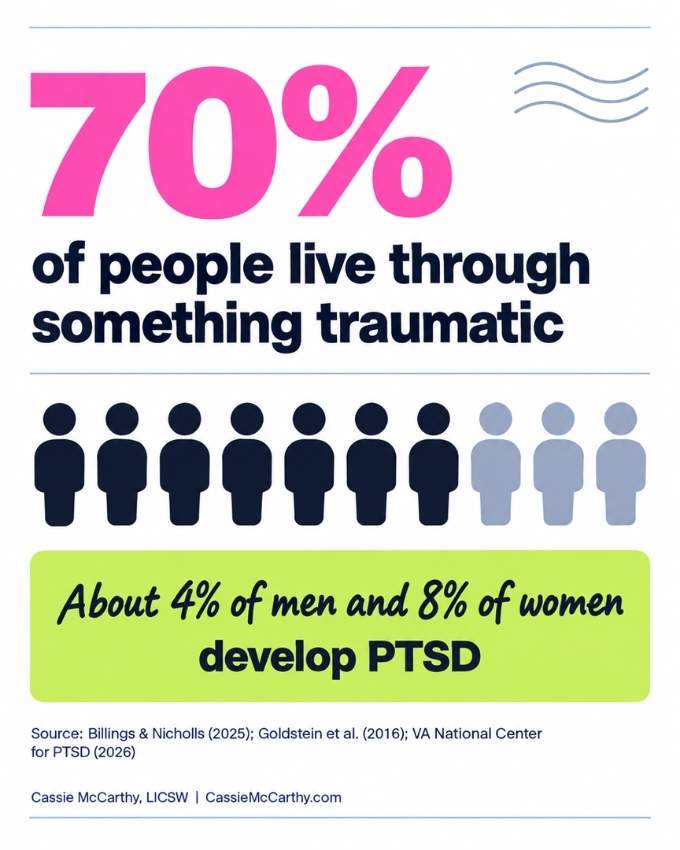
We know that about 70% of people will experience something traumatic in their lifetime (Billings & Nicholls, 2025, p. 2). That’s a pretty high number, but most of them won’t go on to develop PTSD. Most people, when they go through something traumatic, might struggle with the pain of it for a couple of weeks, but with time, they heal and recover on their own.
So it’s really the minority of people who don’t heal, and more women than men. Why more women develop PTSD is a conversation for a whole other post, but a lot of it has to do with how different the nature of women’s trauma is from the trauma men go through.
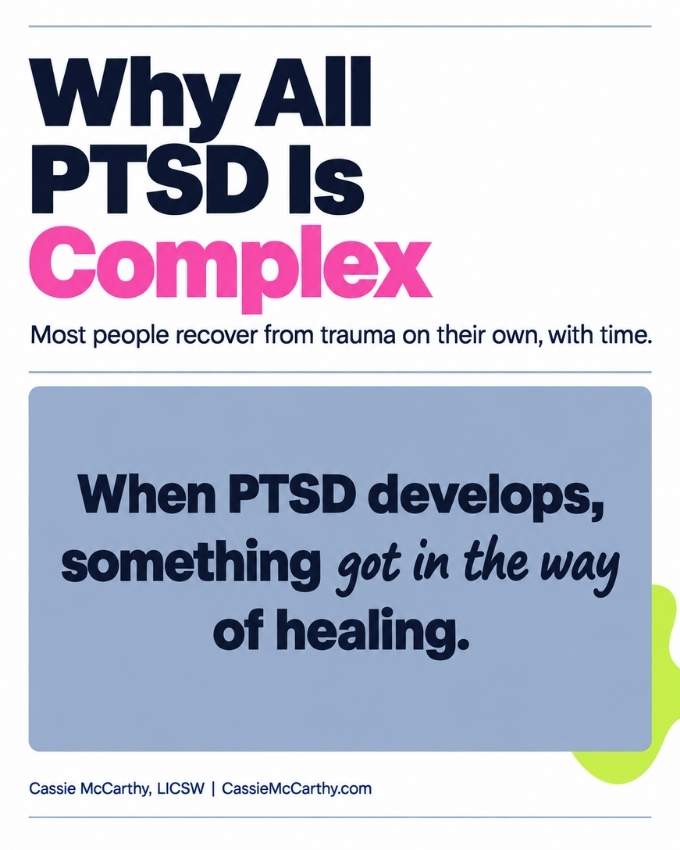
If most people naturally heal from trauma, then for the people who aren’t healing, something else is going on: something that got in the way, something that made it harder, some other variable at play. Something complicated it. So if your PTSD is still there, it has already outlasted natural recovery. That’s why I say anyone who has developed PTSD probably has something complex going on.
This matters for treatment, too. General therapists see everyone, including the people who would have recovered on their own anyway, and they can come to believe their therapy did it (Billings & Nicholls, 2025, p. 3). The people still stuck are the ones who need an evidence-based treatment.
Clinical Reality:
PTSD that is still there has already outlasted natural recovery.
That’s why it needs a trauma-focused treatment, not more time.
CPTSD vs PTSD: The Difference in One Sentence
PTSD is a learned fear response. CPTSD is that same learned fear response plus damage to how you manage your emotions, how you see yourself, and how you connect with other people (International Society for Traumatic Stress Studies [ISTSS], n.d., p. 3). That is the difference between PTSD and CPTSD. In the US, both are PTSD, and the same trauma-focused treatments treat both. Part 3 covers what those are, and I walk through all of it in my video on YouTube.
If You're Exploring Your Own Story →
If what happened to you was relational, and you’ve wondered whether it “counts” because it doesn’t look like what the early research described, you don’t have to sort that out alone. My free checklist walks through the kinds of harm women go through that often get minimized, with real examples under each one. In a few quiet minutes, you’ll have language for what happened and something concrete you can bring to a therapist if you choose to.
If You're A Clinician Supporting This Work →
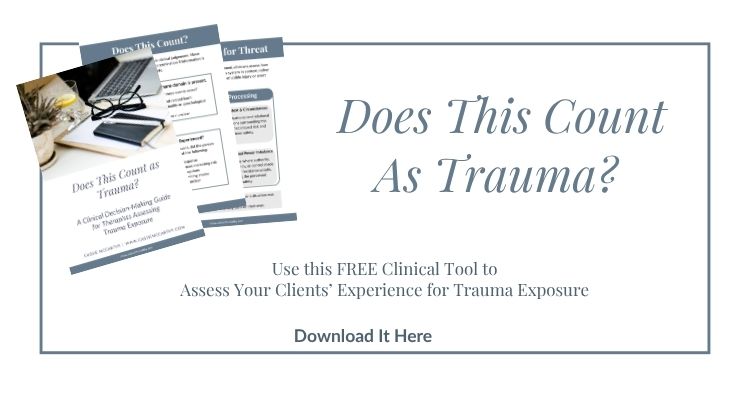
If you’re assessing a client whose trauma was interpersonal and doesn’t fit the event-first picture, my Clinical Decision-Making Guide walks you through how to assess trauma exposure step by step: the decision tree, how to document it, and where it leads on differential diagnosis.
Frequently Asked Questions
Click or tap any question to see the answer. Click or tap again to close.
What Is the Difference Between CPTSD and PTSD?
PTSD is a learned fear response. CPTSD is that same fear response plus problems managing emotions, a negative view of yourself, and difficulty connecting with people. In the US, both are diagnosed as PTSD; the World Health Organization lists them as two diagnoses.
Is CPTSD in the DSM-5?
No. The DSM-5 has no CPTSD diagnosis. In 2013 it widened PTSD to include more of the symptoms traditionally thought of as part of CPTSD, so in the US it’s all PTSD.
When Did CPTSD Become a Diagnosis?
Judith Herman proposed complex PTSD in 1992. The World Health Organization made it a separate diagnosis in its ICD-11, released in 2018. The US manual still has one diagnosis, PTSD.
Is All PTSD Complex?
In my clinical view, in the US, yes. Most people who go through trauma recover on their own with time, so PTSD that develops and stays has already outlasted natural recovery. Something got in the way of healing.
If This Topic Resonates With You, You May Also Find These Articles Helpful
References:
Billings, J., & Nicholls, H. (2025). PTSD and complex PTSD, current treatments and debates: A review of reviews. British Medical Bulletin, 156, 1–13. https://doi.org/10.1093/bmb/ldaf015
Herman, J. L. (1992). Trauma and recovery. Basic Books.
International Society for Traumatic Stress Studies. (n.d.). ISTSS guidelines position paper on complex PTSD in adults.
Larsen, S. E. (2025, December 9). Complex PTSD: History and definitions. PTSD: National Center for PTSD.
🛟 If you're not safe right now, that matters more than anything else in this post.
Use a device he doesn't have access to.
- RAINN National Sexual Assault Hotline: 800-656-HOPE (4673), free and confidential, 24/7
- Text START to 88788 (National Domestic Violence Hotline)
- Chat 24/7 at thehotline.org and press "Chat"
- Call 1-800-799-7233 (SAFE)
If you're in crisis, call or text 988.
Advocates are available in more than 290 languages through an interpreter.

Cassie McCarthy is a trauma therapist who has practiced since 2008, helping women heal from the kind of pain that rarely gets named for what it is. She is rostered in Cognitive Processing Therapy (CPT), is an AASECT Certified Sex Therapist (CST), and practices by telehealth in Massachusetts, Vermont, Virginia, Illinois, and Florida. If you're in one of those states and want to explore working together, you can reach out to schedule a consult.