What is CPTSD? CPTSD stands for complex post-traumatic stress disorder. Internationally, it means the same learned fear response as PTSD, plus damage to how you manage your emotions, how you see yourself, and how you connect with other people. Here in the US, there is no CPTSD diagnosis at all, so the term can mean almost anything.
A lot of the women who ask me what CPTSD is have already been in therapy. Some of them thought they were already doing trauma therapy, and it didn’t help them. Somewhere along the way, a therapist told them, “This isn’t PTSD. It’s complex PTSD, and you need a special therapy just for complex PTSD.”
And what I usually find is that it was PTSD the whole time, and nobody treated it correctly. That’s why they’re continuing to struggle.
Part of the problem is the word itself. Depending on where you live in the world, CPTSD can mean something different. So let’s get clear on what it is.
This is part 1 of a three-part series: here I cover what CPTSD means and what its symptoms are. Part 2, CPTSD vs PTSD, covers where the confusion comes from, and part 3, Is There a Cure for CPTSD?, covers what actually helps people recover.
What Does CPTSD Stand For?
CPTSD stands for complex post-traumatic stress disorder. So to understand what CPTSD is, you first need to understand what PTSD is.
PTSD is post-traumatic stress disorder, and the definition of it kind of lives in its title: post-trauma. After you went through something traumatic, you developed a stress disorder.
And what a stress disorder is, it’s when your brain can no longer tell the difference between threat and stress. So it starts treating both of these things as if they’re one and the same. Anything stressful gets responded to as if it’s a threat, so that you can feel protected and you’re not vulnerable to danger.
Complex PTSD, in theory, takes that to a whole other level. But part of the issue is that the term has become common language, which has confused a lot of people about what it is.
Clinical Reality:
The whole point of a diagnosis is that everyone who uses the term understands what it means, because what it means will then guide treatment.
CPTSD doesn’t give us that common language.
Why the Meaning of CPTSD Depends on Where You Live
One of the problems with CPTSD is that its definition changes based on where you are in the world, and on when and how you first learned about it. It hasn’t been standardized as well as it needs to be.
In the US, we use a manual called the DSM, written by the American Psychiatric Association. It’s kind of the encyclopedia of mental health diagnoses in the US. And the DSM has no CPTSD diagnosis at all (American Psychiatric Association, 2022). We have one diagnosis, PTSD, and it has evolved over time to cover what is internationally known as CPTSD. In the US, it’s all PTSD.
Internationally, the World Health Organization created the ICD, and the ICD does have two different diagnoses: one for PTSD and one for CPTSD.
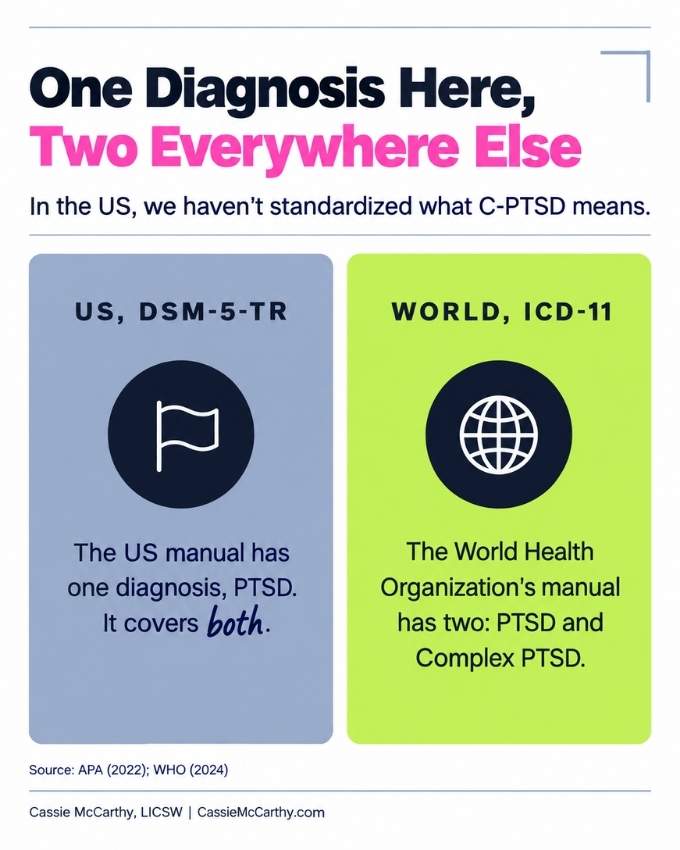
| In the US (the DSM) | Internationally (the ICD) |
| One diagnosis: PTSD | Two diagnoses: PTSD and CPTSD |
| PTSD covers what other countries call CPTSD | CPTSD has its own definition |
| CPTSD is a term people use, not a diagnosis | CPTSD is PTSD plus three added symptoms |
Here is what the ICD says:
“Complex PTSD follows exposure to an event or series of events of an extremely threatening or horrific nature, most commonly prolonged or repetitive events from which escape is difficult or impossible. It includes all three core elements of PTSD: re-experiencing the trauma in the here and now, deliberately avoiding reminders, and persistent perceptions of heightened current threat. And it adds three more: severe and pervasive problems in affect regulation; persistent beliefs about oneself as diminished, defeated or worthless, with deep feelings of shame, guilt or failure; and persistent difficulties in sustaining relationships and in feeling close to others.”
(World Health Organization, 2024, pp. 344–345)
It also has to cause significant impairment in your daily life.
Put simply, internationally they’re saying the trauma exposure for CPTSD can be more intense or more prolonged, but not necessarily. What is different is that the reaction to the traumatic event has these added symptoms. So in the international sphere, CPTSD is any traumatic event that created the three types of PTSD symptoms, plus these three new ones.
What CPTSD Can Mean in the US
In the US, because CPTSD hasn’t been a standardized concept, it gets labeled all kinds of different things. It can mean any of these:
- you experienced several different kinds of trauma
- you went through childhood sexual abuse
- PTSD plus substance use, or plus another mental health condition
- repeated or chronic trauma
- any trauma in childhood
So if two people in the US are saying CPTSD, they could be talking about two very different things. Five different meanings is not a common language, and that’s why I don’t lean on the term. It can create a lot of confusion for people.
What Is Complex Trauma? Cause Versus Outcome
At what point does trauma become complex? When CPTSD was first proposed, it was defined by what happened to you: long-term child abuse, repeated interpersonal violence. It was proposed by a woman named Judith Herman in 1992 (Herman, 1992).
All these years later, it has been redefined. The definition has changed over time from what happened to you to how it impacted you (Larsen, 2025, p. 1; International Society for Traumatic Stress Studies [ISTSS], n.d., p. 2).
When we used to think of CPTSD, we thought of repeated trauma, childhood trauma, sexual trauma. Now we know those are risk factors, but they’re not requirements. They’re often correlated, but correlation does not imply causation. In the words of the International Society for Traumatic Stress Studies, “the experience of chronic or repeated traumas is a risk factor, not requirement for CPTSD” (ISTSS, n.d., p. 3).
Childhood and relational trauma raise the risk of developing it, but they don’t decide the outcome:
- a single event can lead to CPTSD (Larsen, 2025, p. 3)
- years of exposure to trauma can lead to regular PTSD, or nothing
- genes and environment play a part too (ISTSS, n.d., p. 3)
“Childhood and relational trauma raise the risk. They don’t decide the outcome.”
If you’ve spent years wondering whether what happened to you was “bad enough” or “complex enough” to count, that question is the one this whole confusion trains people to ask. I built a checklist for exactly that question. Does This Count As Trauma? A Checklist for Women Who Wonder if What They Went Through Was “Bad Enough” to Be Called Trauma covers the kinds of harm standard checklists leave out, like emotional and psychological abuse, childhood adversity, and violations of trust. You can find it here whenever you’re ready.
CPTSD Symptoms: What It Shares With PTSD, and What It Adds
PTSD is a learned fear response. CPTSD is that same learned fear response, plus damage to how you manage your emotions, how you see yourself, and how you connect with other people (ISTSS, n.d., p. 3). That is the difference between PTSD and CPTSD.
In the US, the diagnosis of PTSD requires five categories of symptoms to have been met. The first is that you experienced a traumatic event. The second is that you try to avoid thinking about it. The third is that you think about it even when you don’t want to. The fourth is that it changes the way you feel about yourself or other people. And the fifth is that it changes how you are physiologically or behaviorally.
Internationally, they divide it differently. There’s PTSD, and then there’s CPTSD, which takes everything we know about PTSD and adds more to the mix (World Health Organization, 2024).
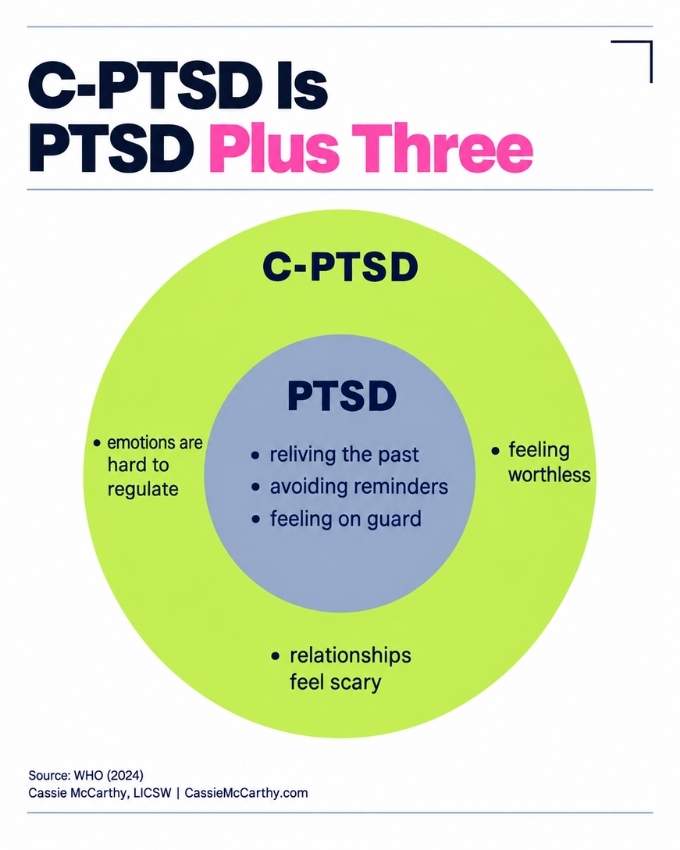
The three that PTSD and CPTSD share
Intrusion
You are thinking about the trauma as if it were a here-and-now experience, even when you don’t want to be. Sometimes you’re thinking about it so vividly it can feel like you’re back there. It’s a spectrum, from kind of seeing it all the way to feeling fully back there. It can be nightmares, and trauma nightmares aren’t only of the event itself. It’s any dream that brings up the emotions or memories from the event, or thoughts, perceptions and emotions related to it that come in when you weren’t trying to conjure them. If you ask yourself what you ate last night, you’re pulling up a memory on purpose. If an image of your plate crosses your mind without you trying to think about it, that’s an intrusion.
Avoidance
You’re trying to avoid thinking about it, avoid triggers, avoid places that remind you of it: anything that could bring on the thought, the memory, or the feelings of being in that traumatic event.
Hypervigilance
The emotional and physiological reactivity to the event. People avoid because they don’t want the constant sense of fear or danger, of being on guard.
The three that CPTSD adds
Affect Dysregulation
Affect means the way you show your emotions, and here it isn’t regulated well. You have really large reactions to small stressors. You might engage in self-destructive behavior. You might have an out-of-body experience, or feel like things aren’t real when you become really stressed, or feel numb. It’s when you don’t feel like you can control your emotions; your emotions are in control of you.
Negative Self-Concept
You’ve begun to believe that you’re less than others: defeated, defective, worthless. You feel intense guilt or shame, especially related to the trauma. It becomes how you see yourself, and it’s really painful. And it has ripple effects, because if you don’t like yourself or can’t trust yourself, how are you supposed to feel safe as you navigate the world?
Relationship Difficulties
It’s hard to sustain closeness. You feel like you need to pull away from people. “People scare me. Trust is terrifying.” Vulnerability feels dangerous, relationships become a potential threat, and you don’t really want to get into them because they can be so harmful.
These three are what researchers group together as the symptoms that set CPTSD apart (Billings & Nicholls, 2025, p. 5).
Clinical Reality:
CPTSD isn’t a different condition from PTSD. It’s PTSD plus three added problems.
That matters for treatment, and it’s the heart of part 3.
CPTSD vs BPD: How to Tell Them Apart
What makes CPTSD different from BPD, borderline personality disorder? This is a very common question, and the two get confused quite often. BPD is an intensely painful condition, and it shouldn’t be diminished. It is also different from CPTSD.
So let’s take CPTSD’s three added symptoms, affect dysregulation, negative self-concept and relationship difficulties, and look at how each one shows up in CPTSD and in BPD (World Health Organization, 2024, p. 348).
| CPTSD | BPD |
| Emotions: the person tries to avoid trauma reminders, because the reminder is what disrupts her | Emotions: dysregulation in all areas of life, a pervasive pattern |
| Sense of self: a stable negative self-concept; she just thinks she’s bad | Sense of self: an unstable identity; she isn’t even sure who she is |
| Relationships: afraid of them, because she sees them as a source of danger and threat | Relationships: a struggle, because she’s afraid of abandonment |
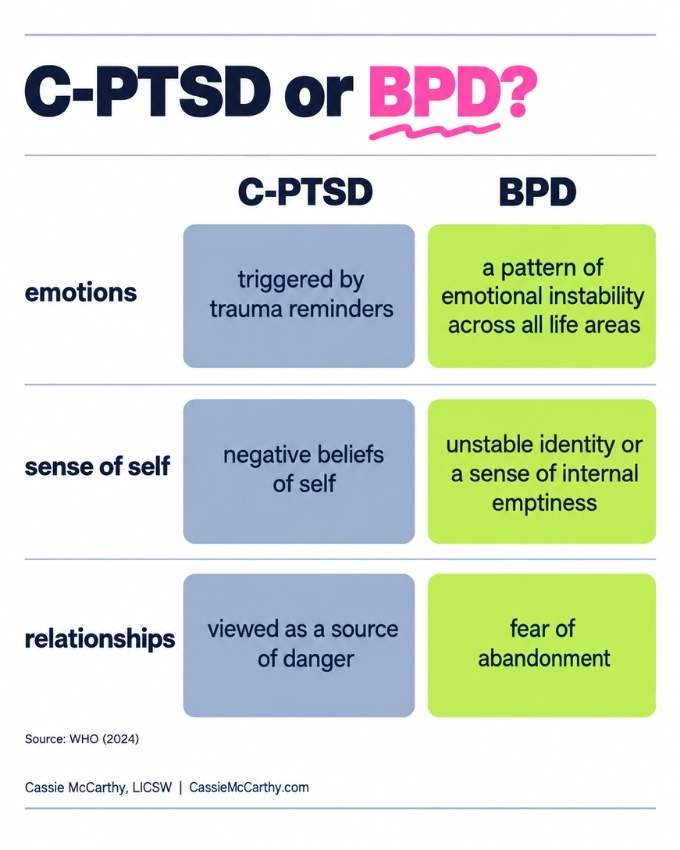
So on the surface, if you look at a person’s behavior, CPTSD and BPD can look similar. But if you get under that and figure out what’s driving the symptoms and what function they serve, that’s what differential diagnosis is, and that’s how you begin to tell them apart. It’s important to tell the two apart because they have two different treatment protocols. And a person could have both.
When to seek an assessment
If you think you have PTSD or CPTSD, it’s really important to be seen by a specialist who can assess for it accurately and thoroughly, so you get the help you need. I walk through all of this, start to finish, in my video on YouTube.
If You're Exploring Your Own Story →
If you’ve been told you have CPTSD, or you’re wondering whether what you went through “counts,” you don’t have to sort it out alone. My free checklist walks through the kinds of harm women go through that often get minimized, with real examples under each one. In a few quiet minutes, you’ll have language for what happened and something concrete you can bring to a therapist if you choose to.
If You're A Clinician Supporting This Work →
If a client has come to you saying “I was told I have complex PTSD,” my Clinical Decision-Making Guide walks you through how to assess trauma exposure step by step: the decision tree, how to document it, and where it leads on differential diagnosis.
Frequently Asked Questions
Click or tap any question to see the answer. Click or tap again to close.
What Is CPTSD?
CPTSD stands for complex post-traumatic stress disorder. In the World Health Organization’s manual, it’s PTSD’s three core symptoms (intrusion, avoidance and hypervigilance) plus three more: trouble regulating emotions, a negative view of yourself, and difficulty with relationships. In the US, there’s no CPTSD diagnosis, so the term gets used in many different ways.
What Is the Difference Between PTSD and CPTSD?
PTSD is a learned fear response. CPTSD is that same learned fear response, plus damage to how you manage your emotions, how you see yourself, and how you connect with other people. In the US, all of it is diagnosed as PTSD.
Do You Need Childhood Trauma to Have CPTSD?
No. Childhood and repeated trauma raise the risk of CPTSD, but they’re risk factors, not requirements. A single event can lead to CPTSD, and years of trauma can lead to PTSD alone, or to nothing.
What Is the Difference Between CPTSD and BPD?
They can look alike on the surface. With CPTSD, the sense of self is stable and negative, and relationships feel dangerous. With BPD, the sense of self is unstable, and relationships are hard because of a fear of abandonment. A trauma specialist tells them apart by looking at what drives the symptoms.
If This Topic Resonates With You, You May Also Find These Articles Helpful
References:
American Psychiatric Association. (2022). Diagnostic and statistical manual of mental disorders (5th ed., text rev.). https://doi.org/10.1176/appi.books.9780890425787
Billings, J., & Nicholls, H. (2025). PTSD and complex PTSD, current treatments and debates: A review of reviews. British Medical Bulletin, 156, 1–13. https://doi.org/10.1093/bmb/ldaf015
Herman, J. L. (1992). Trauma and recovery. Basic Books.
International Society for Traumatic Stress Studies. (n.d.). ISTSS guidelines position paper on complex PTSD in adults.
Larsen, S. E. (2025, December 9). Complex PTSD: History and definitions. PTSD: National Center for PTSD.
World Health Organization. (2024). Clinical descriptions and diagnostic requirements for ICD-11 mental, behavioural and neurodevelopmental disorders. https://www.who.int/publications/i/item/9789240077263

Cassie McCarthy is a trauma therapist who has practiced since 2008, helping women heal from the kind of pain that rarely gets named for what it is. She is rostered in Cognitive Processing Therapy (CPT), is an AASECT Certified Sex Therapist (CST), and practices by telehealth in Massachusetts, Vermont, Virginia, Illinois, and Florida. If you're in one of those states and want to explore working together, you can reach out to schedule a consult.