

You may have had this thought at some point:
Nothing violent happened. So why does this still bother me?
Maybe you have replayed it over and over, trying to make sense of why something that “wasn’t that bad” still shows up as anxiety, self doubt, trouble trusting, or a constant feeling of being on edge.
This is something I hear often in my work with women. And it has a name, even if most people never learn it.
I call it the “It Wasn’t That Bad” syndrome.
It is the belief that unless something involved force, injury, or obvious violence, it does not count as trauma. And that belief keeps many women from getting the support they actually need.
Where the “It Wasn’t That Bad” Belief Comes From
Most of us were taught, directly or indirectly, that trauma looks a certain way.
It is violent.
It is dramatic.
It is obvious.
If there was no weapon, no physical injury, no screaming or fighting back, then maybe it was not really trauma. Maybe you are overreacting. Maybe you should just move on.
This belief is reinforced everywhere. Media portrayals of assault, outdated clinical frameworks, and a culture that struggles to talk honestly about power, consent, and coercion all contribute to it.
But clinically, this belief is wrong.

Trauma is Defined by Threat or Action, Not By Intensity
From a trauma perspective, what matters most is how much danger your nervous system perceived and how much power you had in the moment.
Trauma is defined by threat, powerlessness, and lack of viable choice.
Not by how violent something looked from the outside.
This is where coercion is often misunderstood.
Violation is a Form of Trauma
But coercion can still be traumatic.
Coercion involves pressure, manipulation, persistence, emotional consequences, power imbalances, or situations where saying no did not feel like a real option. There may have been no physical force at all, and yet your nervous system registered danger.
And your nervous system is not dramatic.
It is protective.
Why Your Body May Have Responded with the Freeze Response
Many women minimize their experiences because they did not fight back or explicitly say no. But this misunderstands how survival responses actually work.
When the brain detects threat, it does not ask if something was violent enough to count.
It asks whether you are safe and whether you have a way out.
If the answer is no, the nervous system may shift into freeze, compliance, appeasement, or dissociation.
These are not choices.
They are survival responses.
And importantly, threat does not require force.
Threat does not require a weapon, physical injury, explicit verbal threats, or certainty after the fact.
Threat is assessed in the moment, based on context, power dynamics, and available safety.
How Telling Yourself “It Wasn’t That Bad” Helped Your Survive
Here is the part that often gets missed.
Minimizing what happened may have actually helped you survive.
If you fully acknowledged the danger or powerlessness of the situation at the time, your nervous system may have stayed in a constant state of fear. Downplaying it allowed you to function, move forward, and keep living your life.
In that sense, “it wasn’t that bad” was not denial.
It was adaptation.
But what helps you survive an experience does not always help you heal from it.
The Cost of Minimizing Trauma
Over time, minimizing comes with consequences.
When you tell yourself it was not that bad, you may also start to believe that you are too sensitive, that you cannot trust your own judgment, or that your reactions do not make sense.
The outcome is often chronic self doubt, lowered self esteem, anxiety that does not seem to have a clear cause, difficulty trusting yourself or others, and living in the world with a constant low grade sense of fear or vigilance.
And because the experience does not fit the stereotype of trauma, many people seek help for anxiety or depression without ever addressing the underlying threat that shaped their nervous system in the first place.
If you have ever wondered whether what you went through counts
I created a client centered resource to help you think it through without forcing labels or diagnoses.
Does This Count As Trauma?
A checklist for women who wonder if what they went through was “bad enough” to be called trauma.
It is designed to support clarity, not push conclusions.

Coercion as Threat Based Harm
One of the most common myths I see, both clinically and culturally, is the idea that harm must be overt to be real.
But coercion operates through power, not force.
Power imbalances can exist in relationships, workplaces, families, age differences, emotional dependency, and financial or housing vulnerability.
When refusing carries consequences, whether emotional, relational, or practical, the nervous system may correctly assess the situation as unsafe.
That assessment matters.
Not because it automatically means PTSD, but because it shapes how someone learns to move through the world afterward.
Trauma is Not the Same as PTSD
This distinction is critical.
Identifying trauma exposure does not mean assigning a diagnosis.
Many people with trauma exposure do not meet criteria for PTSD. Others present with symptoms that look more like anxiety, depression, relational distress, or emotional numbing.
Trauma exposure should prompt careful assessment, not automatic escalation or forced trauma focused treatment.
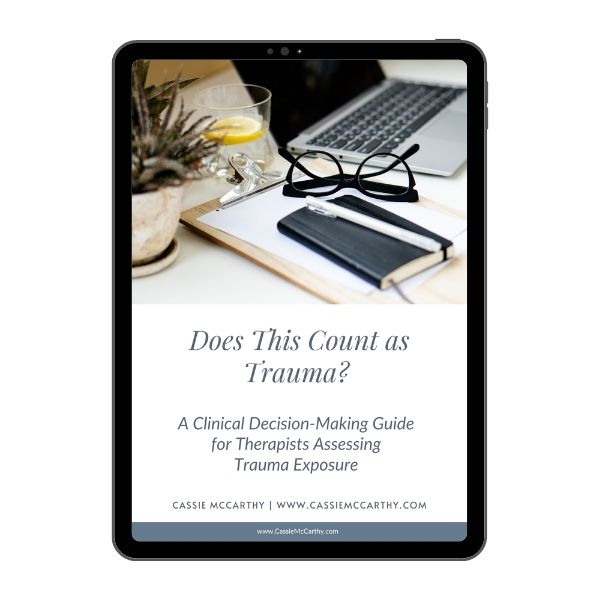
For clinicians navigating these gray areas
I created a structured decision making guide to support accurate and ethical trauma assessment.
Does This Count As Trauma?
A clinical decision making guide for therapists assessing trauma exposure.
It focuses on actual versus threatened harm, contextual threat processing, ethical pacing, and the distinction between exposure and diagnosis.
How Trauma Therapy Helps Without Retraumatizing
When trauma is defined by threat rather than force, treatment must be thoughtful.
In my work, I use evidence based trauma therapy, particularly Cognitive Processing Therapy, to help clients understand how threat shaped their beliefs, reduce self blame and confusion, rebuild trust in their own judgment, and learn how to live without constant fear or self doubt.
This work is not about reliving what happened or forcing meaning before someone is ready. It is about restoring agency, clarity, and safety.
There is a way forward
If this resonates, it does not mean you are broken.
It means your nervous system did what it was designed to do.
Healing does not require you to prove that something was bad enough.
It requires understanding what was at stake for you and learning how to move forward without minimizing yourself.
Therapy Support
I work with women who have experienced sexual trauma, coercion, and relational harm using structured, evidence based trauma therapy.
If you live in Massachusetts, Illinois, Virginia, Vermont, or Florida, you can reach out to schedule a consultation to see whether this approach is the right fit.
You do not have to keep carrying this alone, and you do not have to keep telling yourself it was not that bad in order to survive.
For Therapists & Clinicians:
Are you ready to offer this level of care? Take the Trauma-Focused Provider Readiness Self-Assessment in my toolkit to assess your readiness for TFC training.