
The Trauma-Informed Intake Toolkit
Where Trauma Theory Becomes Real Clinical Practice.
A home-study course for therapists offering 5.25 continuing education hours*
On Your Time. At Your Pace. In Your Space.
One-time investment of $247 for lifetime access
*See FAQ section for official CE approval and credit details.
A Clear, Trauma-Informed Intake Process That Protects Clients, Reduces Dropout, and Strengthens Your Clinical Confidence.
This isn’t another course about trauma theory – this is the actual “how to do the intake” training clinicians have been asking for.
The intake should set the tone for treatment—not spark confusion, anxiety, or documentation fatigue. If you find yourself feeling overwhelmed, drained, or unsure whether you’re assessing trauma accurately or making the right treatment decisions, you are absolutely not alone. I created this for you.
The Trauma-Informed Intake Toolkit is an asynchronous, self-paced home-study training designed to help you streamline your entire intake workflow—and build grounded clinical confidence in assessing trauma, identifying symptom patterns, and determining what level of care each client needs—all while practicing ethically, competently, and with trauma-protective principles from the very first point of contact.
Get the exact structure, trauma-informed inquiry scripts, and ready-to-use templates you need to run an effective, clinically sound trauma-informed intake. This Toolkit is designed to eliminate the need for guessing, Googling, or constantly reinventing the wheel—so you can walk into every intake knowing exactly what to ask, what you’re looking for, and how to make clear, defensible treatment decisions.
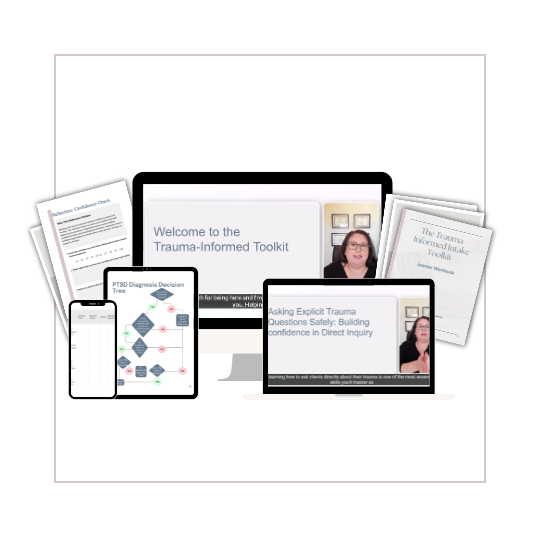
If the intake has ever felt overwhelming, confusing, or unclear – this is the step-by-step structure you’ve been missing.
Who This Course Is For
This Trauma-Informed Intake Toolkit is designed for graduate-level mental health professionals (social workers, counselors, psychologists, family therapists, etc).
To enroll, you must be a licensed or pre-licensed mental health professional, or a graduate student in a qualifying mental health program.
This training is the right fit if:
- You recently moved into private practice and miss the built-in safety net of agency paperwork and intake structures.
- You are a conscientious generalist who treats anxiety and depression, but you want to stop guessing when complex trauma shows up in the room.
- You dread your documentation, constantly worrying if your intake notes and treatment plans are clinically defensible enough to withstand an audit.
- You are drawn to trauma work but don’t feel ready for advanced modalities (like CPT or EMDR) and need a foundational framework to practice safely now.
- You feel drained by unstructured intakes and need a system that creates containment, boundaries, and clarity from the very first contact.
Right Now, Your Intake Process Feels Harder Than It Should
You might be unsure how to organize the session, what to ask, or how deep to go when trauma comes up. Documentation often feels stressful—leaving you wondering if your notes are truly solid and audit-safe. You need CEUs, but losing an entire day of client income just isn’t an option.
Mostly, you’re simply tired of guessing your way through trauma intakes without a structure you can rely on.
But Imagine Something Different.
Imagine walking into your next intake knowing exactly how to structure the hour, what questions to ask, and how to spot red flags without second-guessing yourself.
Imagine an intake process where you:
- Onboard clients with minimal friction, creating a seamless experience that reduces early dropout.
- Know exactly what to ask and look for, pacing trauma discussions without overwhelming anyone.
- Rely on tools, documentation practices, and systems that protect both you and your client.
Learn on your own time, building skills you can use immediately without disrupting your income.
Your Intake
Transformed
From Winging It → To Structured Safety
Move from hoping you won’t trigger a client to using a clear, trauma-informed roadmap that safely paces every intake session.
From Audit Anxiety → To Defensible Documentation
Stop rewriting notes late at night. Start producing clear, clinically sound, medical-necessity–aligned documentation in a fraction of the time.
From Imposter Syndrome → To Clinical Precision
Replace guessing with the LID Method—confidently distinguishing trauma symptoms from anxiety, depression, and other clinical presentations.
From Chaotic Systems → To Friction-Free Onboarding
Stop reinventing the wheel for every client. Build trauma-protective systems that reduce dropout, increase clarity, and protect your time and energy.
From Scrambling → To 5.25 CE Hours
Earn high-quality CE credit on your schedule, without losing a full day of client income or attending rigid live trainings.
Stop carrying the mental load of “figuring it out as you go” — and start practicing with the clarity, structure, and ethical protection both you and your clients deserve.
Inside the Toolkit, You Will…

🧠 Understand What Trauma Looks Like in the Room
Learn how trauma presents—emotionally, cognitively, behaviorally, physiologically, and relationally—so you can recognize trauma responses even when they aren’t obvious at first glance.
📚 Apply Every Skill Through a Full, Start-to-Finish Case Study
Follow one client’s journey from the very first point of contact through intake, assessment, diagnosis, treatment planning, and documentation. Watch exactly how to onboard, ask difficult trauma questions, interpret clinical data, identify symptom patterns, and document using the Golden Thread—so you’re not just hearing concepts, but seeing them applied step-by-step in real clinical practice.
🔍 Ask About Trauma Confidently and Clinically
Use practical script-building exercises, step-by-step inquiry processes, and guided practice activities that help you explore trauma histories thoroughly and safely—while staying within what can be ethically and clinically held in an intake.
🧩 Assess Trauma Patterns With Clarity
Translate client narratives into clinically meaningful trauma symptom patterns, distinguish trauma from other mental health conditions, and identify red flags that signal the need for stabilization or specialized treatment.


🛡️ Build Trauma-Protective Systems From First Contact
Use the Four-Step Friction-Free Onboarding System to create safer, more contained workflows across email, phone, telehealth, EHR, forms, and communication preferences—so clients feel grounded, you feel organized, and early dropout decreases.
✍️ Master the Golden Thread—Effortlessly
Use a simple, trauma-informed documentation method to link intake findings → treatment goals → progress notes in a way that supports clinical reasoning, medical necessity, and defensible decision-making.
💡 Know Exactly When to Refer
Gain clarity on Trauma-Informed Care vs. Trauma-Focused Treatment, what falls within your clinical scope, and how to identify who needs grounding, stabilization, or specialty trauma work.
🎧 Learn on Your Schedule
Earn up to 5.25 continuing education hours (approval pending) in a fully on-demand format with concise lessons, clinical demonstrations, a full-case walkthrough, trauma inquiry scripts, and a downloadable workbook you can use immediately.

No webinars. No rigid timelines. Learn when you want, how you want.
CE hours include workbook and reading time in addition to video lessons.
The Course Curriculum: A Look Inside
A clear, structured path that walks you from foundational trauma concepts to real-world clinical application—supported by a full, start-to-finish case study woven throughout the course.
Module 1: Foundations of Trauma-Informed Intake & Clinical Scope
Lay the groundwork for safe, ethical clinical practice. You will clarify exactly what trauma is (and isn’t) and master the critical distinction between Trauma-Informed Care vs. Trauma-Focused Care—ensuring you always practice within your ethical scope.
Lessons:
- Welcome to the Trauma-Informed Intake Toolkit (5:17 min)
- Clarifying Practice Boundaries: Trauma-Informed Care vs Trauma-Focused Care (5:14 min)
- What Counts as Trauma: Recognizing Exposure and Overlooked Harm(10:34 min)
Module 2: Trauma-Informed Practice Essentials: Screening, Onboarding & Assessment
Design intake workflows that regulate rather than overwhelm—before the session even begins. Learn to build Trauma-Protective Systems, create a friction-free onboarding process that reduces client anxiety and dropout, and select the right standardized screening tools for your practice.
Lessons:
- Trauma-Protective Systems: Safeguarding Client Privacy and Emotional Safety (4:40 min)
- The Four-Step Friction-Free Client Onboarding System (5?26 min)
- Evidence You Can Trust: Choosing and Using Standardized Assessment Tools (7:50 min)
Module 3: Conducting the Trauma-Informed Intake: How to Assess, Diagnose, and Build Therapeutic Trust
This is your core “how-to” module. Learn exactly how to structure the intake hour, ask direct questions about trauma exposure safely, and interpret clinical information to make sound recommendations. You will follow a multi-part case study that illustrates every step in real-time practice—giving you the clear, practical “how-to” clinicians consistently ask for.
Lessons:
- Building Rapport, Safety and Cultural Responsiveness From the First Minute (6:36 min)
- Asking About Trauma Safety: Building Confidence in Direct Inquiry (12:21 min)
- From Distress to Diagnosis: Identifying Trauma Symptoms During Intake (14:02 min)
- From Assessment to Action: Making Diagnosis & Communicating Treatment Recommendations (14:28 min)
- Setting Expectations, Boundaries and Closing the Intake (4:10 min)
Module 4: Trauma-Informed Documentation & Treatment Planning: The Golden Thread from Intake to Intervention
Strengthen your documentation with a trauma-informed approach that ensures clarity, medical necessity, and audit-level defensibility—without hours of rewriting. You’ll continue using the case study to apply these skills directly to treatment planning.
Lessons:
- Trauma-Informed BPSS: Weaving the Golden Thread from Intake to Intervention (5:07 min)
- Writing What Matters: How to Document Trauma-Related Care Accurately & Ethically (8:46 min)
- From Plan to Purpose: Writing a Trauma-Informed Treatment Plan (4:55 min)
- Weaving It All Together: The Golden Thread in Documentation (2:36 min)
Module 5: Integration, Referral & Ongoing Competency
Bring everything together with a clear framework for long-term practice. Learn how to handle dissociation during intake, determine exactly when a referral is necessary, and assess your readiness for future trauma-focused training and growth.
Lessons:
- When to Refer a Client to Trauma-Focused Therapy (12:29 min)
- Addressing Dissociation in the Intake (10:54 min)
- Becoming a Trauma-Focused Provider: Readiness, Competency, and Sustainability (6:41 min)
- Closing Reflections & Next Steps (3:30 min)
About Your Instructor:
Catherine (Cassie) McCarthy, LICSW is a seasoned trauma specialist and clinical educator with over 16 years of experience focusing exclusively on PTSD, relational, and complex trauma. She holds an MSW from Simmons College (2008) and is a Licensed Independent Clinical Social Worker in Massachusetts, Illinois, Vermont, Virginia, and Florida. Her advanced training includes extensive experience as a rostered Cognitive Processing Therapy (CPT) therapist, clinical supervisor, and trainer.

Uniquely Qualified in Trauma-Focused Care, Clinical Documentation Standards, and Maintaining Compliance.
Cassie’s expertise is uniquely informed by her background behind the curtain of payer systems. She spent four years working directly for multiple insurance companies, including time as a chart auditor, performing the very audits and utilization reviews that clinicians dread.
This combination of deep clinical specialization with insider knowledge of compliance and medical necessity standards ensures that this Toolkit is built not only on best clinical practice but on defensible business strategy.
She is a former adjunct professor at the graduate level and an experienced instructional designer in clinical education. Her mission is to translate complex compliance requirements into simple, trauma-protective systems that protect your clients, your time, and your practice’s financial health.
How Does It All Work?
5 Easy Steps From Registration to Completion
The enrollment process has been designed to be as friction-free as the intake system itself. Here is exactly what happens when you join:
1
Purchase the Course Through a Secure Checkout
Click the button below to create your learner account. During the secure checkout process, you will be asked to check a box confirming that you are a graduate-level mental health professional or trainee under supervision of a licensed professional.
2
Instant Access to Your Dashboard
Upon registration, you will receive an automated email with your login details. You can log in immediately to access the Learner Dashboard, where your video modules, downloadable workbook, and clinical templates are waiting for you.
3
Learn at Your Own Pace
This is a non-interactive, 100% asynchronous, home-study program that follows a hybrid model of video lessons and required reading. You can watch the video lessons, complete the readings, and use the workbook exercises on your own schedule—whether that’s between sessions, on weekends, or one module at a time.
4
Pass the Test
To complete the program, you must watch all of the videos in the course and complete all of the readings and workbook exercises. You will then be ready to take a final knowledge assessment (quiz) based directly on the course objectives and learning materials. You must score 80% or higher to pass, and you can retake the assessment if necessary.
5
Receive Your Certificate
Upon passing the assessment and completing the course evaluation, the system will automatically mark the course as complete. You will be able to download a Certificate of Completion documenting 5.25 hours of specialized instruction for your records.
Note: To support your progress and maintain platform security, accounts remain active as long as you are engaged. Accounts with 3 months of inactivity may be archived, so we encourage you to jump in and start learning!
Course Objectives:
After completing this program, participants will be able to:
- Differentiate trauma-informed care from trauma-focused treatment and apply this distinction to ethical scope of practice and referral decision-making.
- Conduct a trauma-informed intake using trauma-protective systems, structured inquiry, rapport-building micro-skills, and standardized assessment tools.
- Translate client-reported distress into clinically meaningful trauma symptom patterns and develop accurate, scope-aligned diagnostic impressions.
- Implement trauma-informed documentation and treatment planning using the Golden Thread of medical necessity and consistent clinical reasoning.
- Make clinically appropriate decisions regarding grounding, dissociation, trauma-focused referral, and ongoing professional competency.
Frequently Asked Questions
When will the course launch and what is the cost?
The Trauma-Informed Intake Toolkit is scheduled to launch in January 2026 with a fee of $247 for the full course, workbook, and all supplemental materials.
Will I receive CE hours for this training?
The Trauma-Informed Intake Toolkit has applied for 5.25 continuing education hours. Upon final approval, the official credit designation will be:
The Trauma-Informed Intake Toolkit, Course # 6554, is approved by the Association of Social Work Boards (ASWB) Approved Continuing Education (ACE) program to be offered by Cassie McCarthy, LICSW, INC. as an individual course. Regulatory boards are the final authority on courses accepted for continuing education credit. ACE course approval period: 12/8/2025-12/8/2027. Social workers completing this course receive 5.25 clinical continuing education credits.
How is this different from other trauma training I have taken before?
This course is heavy on the technical “how-to”—focusing entirely on actionable workflows, documentation, and the Golden Thread method. We bypass theory to give you immediate, practice-ready tools.
How long is the course and how quickly can I implement it?
The course contains approximately 2.5 hours of core video lessons and approximately 3 hours of reading time, for a total of 5.25 CE hours. It is designed to be completed and implemented in your practice in a short period of time.
What exactly is included in The Trauma-Informed Intake Toolkit?
The Toolkit is a comprehensive, self-paced home-study training that walks you step-by-step through a trauma-informed, ethically sound intake process. When you enroll, you’ll get access to a complete system of tools, lessons, and templates you can use immediately in your practice, including:
🎥 19 High-Impact Video Lessons (Approx. 2.5 Hours): Across five clinically grounded modules that teach you the entire trauma-informed intake process from first contact to treatment recommendations.
📘 The Trauma-Informed Intake Toolkit Workbook — your required instructional text and full companion guide, featuring:
- Handouts breaking down key trauma-informed intake concepts
- Scripts & phrasing guides for safe, direct trauma inquiry
- Documentation templates including Golden Thread examples
- Intake question script for structured, trauma-informed assessment
- Audit tools (e.g., Trauma-Protective Systems Audit) to evaluate your practice workflows
- Checklists for onboarding, intake, and documentation steps
- Reflection prompts to deepen clinical reasoning
- Practice exercises to apply the skills to real-world scenarios
- Case vignettes to illustrate common trauma-presenting situations
- Decision aids for treatment planning and referral decisions
🗂 “Does This Count as Trauma?” Quick-Reference Checklist: A concise tool you can use during assessment or treatment planning to increase clarity and reduce uncertainty.
📝 Final Quiz + Certificate: To meet CE requirements and validate competency.
What do I get for joining the waitlist?
You’ll receive early updates about the course and be the first to know when enrollment opens. That’s it—no obligation and no commitment.
Does joining the waitlist commit me to buying the course?
No — joining the waitlist simply keeps you updated. It’s completely obligation-free.
What technology is required to complete this course?
The course is video-based and hosted on TutorLMS. To successfully access and complete the program, you will need:
- A stable internet connection (minimum 1.5 Mbps) for video streaming
- An updated web browser (Chrome, Firefox, Safari, or Edge)
- A device capable of viewing and downloading PDF documents
Are there any pre-requisites for this course?
Yes. Participation in this course requires a minimum of a Master’s degree (or current enrollment in a graduate program) in a counseling, social work, or psychology field.
How are CE hours earned?
To earn your CE hours, you must complete all learning modules and video lessons (19 total) as well as read all of the required materials in the Learner Workbook and accompanying downloads. You will then take a 30-question quiz and must pass with a minimum score of 80%. Participants are permitted to retake the post-test an unlimited number of times if a passing score is not achieved initially. All learners are required to complete a course evaluation. Once all of these requirements are met, you will receive your certificate of completion.
I bought the course, but how do I log in?
Please consider bookmarking this link.
Course Policies & The Fine Print
Fees, Refunds, and Cancellations Policy
Program Fees
The fee for this program ($247) is listed clearly on all promotional and registration materials. Full payment is required at the time of registration to gain access to course materials.
Refund Policy
Because this program provides immediate access to digital educational content, all sales are final and non-refundable.
Refunds will not be issued for:
- Non-participation
- Failure to complete the course
- Technology issues related to the participant’s device, browser, or internet connection
- Change of schedule or personal circumstances
If a technical issue originates from our system and prevents access to course materials, we will work promptly to resolve the issue to ensure full course access.
Participant Cancellation
Participants may cancel their enrollment at any time; however, cancellation does not result in a refund due to the immediate availability of digital course materials.
Course access continues until the published access expiration date.
Provider Cancellation Asynchronous/Home-Study Components
In the unlikely event that the course is permanently discontinued, the provider will make every effort to provide 60 days’ notice to allow active students to complete the program.
If the course must be removed without this notice period, a full refund will be issued to any participant who registered within the 3 months prior to cancellation and has not yet completed the course.
Instructions for Accessing ADA Accommodations & ADA / Accessibility Policy
Commitment to Accessibility
Cassie McCarthy, LICSW INC is committed to providing accessible, inclusive, and equitable continuing education experiences for all participants. In accordance with the Americans with Disabilities Act (ADA), Section 504 of the Rehabilitation Act, and all applicable state and federal laws, reasonable accommodations will be made to ensure full participation in both live and asynchronous (home-study) programs.
Accommodations will be considered for all course components, including instructional videos, written materials, assessments, and learning activities. This policy meets accessibility requirements for NBCC ACEP, ASWB ACE, and APA CE programs.
Requesting Accommodations
Participants may request accommodations at any time before or during the course. To request support, contact:
Cassie McCarthy, LICSW INC
Email: info@cassiemccarthy.com
Phone: 978-403-6400
Business mailing address: 82 Tremont St, Salem, MA 01970
Website: www.CassieMcCarthy.com
Please include:
- Your name
- The course you are attending
- The specific accommodation(s) requested
Every request will receive a response within 5 business days, and all approved accommodations will be implemented as quickly as possible. Requests made prior to the start of the course or before initiating a home-study program enable the most timely support.
Examples of Reasonable Accommodations
Reasonable accommodations may include, but are not limited to:
- Closed captioning or transcripts for video content
- ASL interpretation for live/virtual synchronous components
- Alternative formats for written materials (large print, screen-reader–compatible PDFs)
- Extended time for learning assessments or interactive activities (if applicable)
- Adjustments to online platform navigation
- Support for sensory, mobility, or processing needs
If an accommodation cannot be met in the exact form requested, we will collaborate to identify an effective, reasonable alternative.
Confidentiality
All accommodation requests are confidential. Information is shared only with individuals responsible for evaluating or implementing accommodations. Confidentiality practices comply with NBCC, ACE, and APA standards for learner data protection.
Grievance Procedure for ADA Concerns
If you believe your accommodation request has not been handled appropriately, you may submit a formal complaint at any time. ADA-related grievances follow the organization’s standard Complaint & Grievance Policy, which includes:
- How to file a complaint
- How complaints are reviewed
- Expected response timelines
- Escalation options
To initiate a grievance or request the grievance policy, email: info@cassiemccarthy.com.
ACE Individual Course Approval Statement
The Trauma-Informed Intake Toolkit, Course # 6554, is approved by the Association of Social Work Boards (ASWB) Approved Continuing Education (ACE) program to be offered by Cassie McCarthy, LICSW, INC. as an individual course. Regulatory boards are the final authority on courses accepted for continuing education credit. ACE course approval period: 12/8/2025-12/8/2027. Social workers completing this course receive 5.25 clinical continuing education credits.
Course Completion Requirements
To receive continuing education hours, participants must complete the program in full, which includes viewing all instructional video modules and completing the required workbook readings. Attendance and progress are monitored via the learning management system (LMS). Additionally, participants must complete the course evaluation and pass the post-test with a minimum score of 80%. Participants may retake the post-test an unlimited number of times if a passing score is not achieved initially. Certificates of completion are issued immediately upon meeting these requirements.
Diversity, Equity, and Inclusion Policy
Cassie McCarthy, LICSW, INC. is committed to equal opportunity and strictly prohibits discrimination or harassment in any aspect of its continuing education programs. We do not discriminate on the basis of gender, race, creed, national origin, sexual orientation, religion, age, organizational membership, disability, or any other basis prohibited by law or counter to the social work profession’s codes of ethics.
We strive to create a learning environment that supports diversity and inclusion. If you have concerns regarding this policy, please contact info@cassiemccarthy.com.
Date the Course was Created:
The Trauma-Informed Intake Toolkit was created on November 5, 2025