

Many women expect relief when they finally say no.
Instead, they feel guilt.
They set a boundary and immediately question themselves.
They limit access and feel selfish.
They say they cannot do something and then spend hours worrying they were too harsh.
The guilt can feel so intense that it becomes easier to go back to the old pattern.
This often leads to a painful conclusion.
“I must be doing something wrong.”
Clinically, that is rarely the problem.
Boundary guilt is not evidence that you are selfish. It is evidence that your nervous system learned something about safety in relationships.
Boundaries Trigger Guilt When You Learned To Put Others First
If you grew up or lived in environments where your needs were secondary, boundaries feel unnatural.
Many women were taught, directly or indirectly:
- Keep the peace.
- Be accommodating.
- Do not make things harder.
- Do not disappoint people.
- Be grateful.
Over time, putting other people first becomes linked to safety.
When you meet expectations, things stay calm. When you comply, relationships remain stable. When you absorb discomfort, conflict decreases.
The nervous system learns that self-sacrifice maintains connection.
So when you set a boundary later in life, the body reacts as if you have done something dangerous.
The guilt is not moral. It is conditioned.
Societal Expectations Reinforce Boundary Guilt
Boundary guilt is also reinforced culturally.
Women are often socialized to be agreeable, nurturing, flexible, and emotionally responsible for others. Assertiveness can be labeled as cold. Limits can be labeled as dramatic. Saying no can be interpreted as selfish.
When those messages are repeated over time, they become internal rules.
“If I prioritize myself, I am wrong.”
“If I disappoint someone, I am unkind.”
“If I do not meet expectations, I am failing.”
These beliefs are rarely examined. They are absorbed.
When a boundary challenges those rules, guilt follows.
People Pleasing As Emotional Safety Strategy
People pleasing is often misunderstood as personality.
Clinically, it is often a safety strategy, and is sometimes called Fawning.
If you learned that anger, withdrawal, criticism, or instability followed disagreement, you adapted. You monitored others’ moods. You anticipated reactions. You adjusted yourself to reduce risk.
This was not weakness. It was intelligence under constrained conditions.
But when that strategy becomes automatic, it continues long after the original threat is gone.
Setting a boundary then feels like removing a layer of protection.
Your nervous system reacts accordingly.

When You Were Told Your Boundaries Were Wrong
Many women have explicitly been told that their limits are unreasonable.
“You are too sensitive.”
“You are overreacting.”
“You are selfish.”
“You are making this about you.”
When these responses follow boundary setting, the brain learns a simple equation.
Boundary equals rejection.
Even years later, that equation remains active.
The guilt you feel is often the echo of past invalidation.
What Boundaries Actually Are
Boundaries are not punishments.
They are not attacks.
They are not ultimatums.
A boundary is the recognition that something in you deserves protection.
It is the acknowledgment that your time, body, energy, and emotional capacity are not public resources.
It is the belief that your needs are worthy of being met.
When you set a boundary, you are not controlling someone else. You are clarifying what is acceptable to you.
That distinction matters.
Who Has A Problem With Your Boundaries
There is an uncomfortable truth about boundaries.
The only people who consistently object to them are people who benefited from you not having them.
If someone’s comfort depended on your silence, your compliance, or your self-sacrifice, your boundary disrupts that arrangement.
That disruption does not mean your boundary is wrong.
It means the previous dynamic worked in their favor.
When guilt tells you that you are selfish for setting limits, it is worth asking a clarifying question.
Who benefited from me not having boundaries?
Often, the answer shifts the narrative.
Why The Fear Of Being Selfish Feels So Powerful
The fear of being selfish is rarely about morality.
It is about belonging.
If your nervous system learned that approval required compliance, then asserting yourself feels like risking connection.
The guilt is not a verdict. It is a signal that an old safety rule has been activated.
That rule may no longer be accurate.
But it once protected you.
Understanding that difference allows you to respond with precision instead of shame.
If Boundary Guilt Feels Familiar
If you notice guilt every time you assert yourself, that pattern is worth examining.
Many women assume boundary guilt means they are doing something wrong. In reality, it often means they were never given permission to prioritize themselves.
If you are unsure whether past experiences shaped how safe it feels to have needs, I offer a client-centered resource called Does This Count As Trauma: A Checklist For Women Who Wonder If What They Went Through Was “Bad Enough” To Be Called Trauma. It helps identify experiences where pressure, threat, or power imbalance shaped relational patterns, even if no one labeled it trauma at the time.
The goal is clarity, not overidentification.

How I Treat Boundary Guilt In Trauma Therapy
In therapy, boundary guilt is not treated as a confidence issue.
It is treated as a belief system.
Using Cognitive Processing Therapy skills, we identify the beliefs driving the guilt, such as:
- “My needs are less important.”
- “Saying no will damage the relationship.”
- “If someone is upset, I am responsible.”
- “Having limits makes me selfish.”
These beliefs are evaluated for accuracy based on the conditions in which they formed.
We separate what you were responsible for from what you were not. We examine whether conflict truly equals danger now, or whether that association belongs to the past.
This work restores accurate responsibility and reduces unnecessary guilt.
Over time, boundaries begin to feel less like threats and more like alignment.
For Therapists Working With People Pleasing And Boundary Guilt
When clients present with chronic guilt after setting limits, the task is not to encourage stronger assertiveness alone. It is to assess whether boundary fear developed in response to relational threat or coercion.
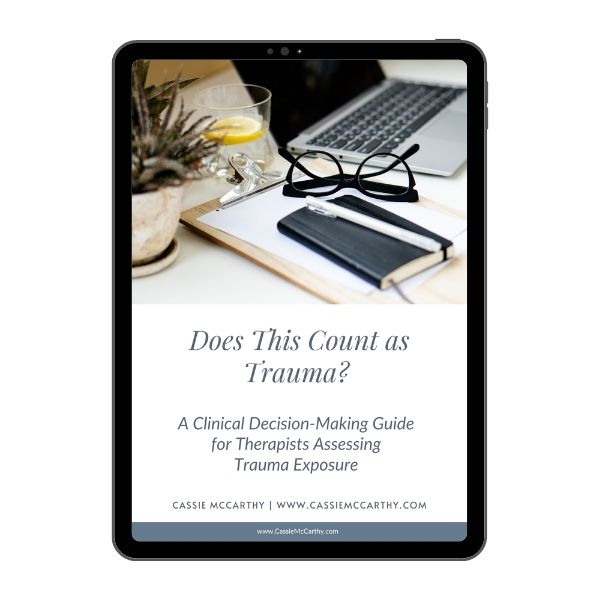
I offer a clinician resource titled Does This Count As Trauma: A Clinical Decision Making Guide For Therapists Assessing Trauma Exposure. It supports more accurate identification of threat, constrained choice, and responsibility distortion in relational dynamics.
Clarity improves formulation and treatment.
Guilt Does Not Mean You Are Wrong
Feeling guilty does not mean your boundary is inappropriate.
It often means you are doing something new.
It means you are interrupting a pattern that once protected you.
Boundaries do not make you selfish.
They make you responsible for yourself.
Trauma Therapy For Women In MA, IL, VA, VT, And FL
If you live in Massachusetts, Illinois, Virginia, Vermont, or Florida, I offer trauma-focused therapy for women struggling with boundary guilt, people pleasing, and fear of being selfish.
You do not need to eliminate guilt before setting limits. You only need to be willing to examine where that guilt came from.
Boundaries are not betrayals.
They are corrections.