

Many women describe themselves with the same words.
“I hate conflict.”
“I just want everyone to be okay.”
“I have to get everything right.”
They often frame these traits as personality. They see themselves as agreeable, responsible, driven, accommodating.
But when these patterns are rigid, fear-based, and exhausting, they are often not personality traits.
They are trauma responses.
Avoiding conflict, people pleasing, and perfectionism frequently develop when resistance was punished and compliance felt safer.
Peacekeeping Develops When Resistance Is Punished
The nervous system learns through experience.
If disagreement led to anger.
If boundaries led to withdrawal.
If mistakes led to criticism or humiliation.
You adapt.
You monitor tone.
You adjust your words.
You soften your needs.
You avoid upsetting people.
This is not weakness.
It is relational threat conditioning.
When the body learns that conflict equals danger, it prioritizes peacekeeping over preference.
Over time, the ability to detect what you want becomes secondary to preventing what you fear.
The Compliance Survival Skill
Many women were taught early that other people’s comfort mattered more than their own.
You may have learned:
- Do not talk back.
- Do not be difficult.
- Keep the peace.
- Be grateful.
- Be helpful.
When approval and stability depend on compliance, compliance becomes a survival skill.
This pattern is often reinforced culturally. Girls are praised for being accommodating. Assertiveness is labeled as attitude. Boundaries are interpreted as selfishness.
The result is a learned reflex.
When tension appears, you smooth it.
When someone is upset, you fix it.
When expectations are unclear, you overperform.
This reflex can follow you into adulthood long after the original environment is gone.
Guilt And Fear After Trauma
After relational trauma, guilt and fear often drive behavior.
You may fear that someone being angry means you are unsafe. You may equate disappointment with rejection. You may experience intense anxiety when someone is upset with you.
This is not because you are fragile.
It is because your nervous system linked conflict with harm.
When conflict was historically followed by punishment, instability, or emotional withdrawal, avoiding it became protective.
People pleasing then becomes a way to prevent escalation.
The behavior looks generous.
The motivation is safety.

Perfectionism As An Attempt At Control
Perfectionism often develops alongside people pleasing.
If mistakes once led to serious consequences, you may attempt to eliminate mistakes entirely.
You prepare excessively.
You overdeliver.
You handle everything yourself.
You anticipate problems before they occur.
Perfectionism can look like ambition or high standards. But when it is driven by fear of catastrophic outcomes, it functions as control.
If nothing goes wrong, no one can be upset.
If no one is upset, you are safe.
The problem is that control is never complete.
The more you attempt to eliminate risk, the more anxious you become about what cannot be controlled.
Perfectionism then reinforces hypervigilance.
Why These Patterns Feel So Hard To Stop
Avoiding conflict and striving for perfection often worked at one time.
They reduced escalation.
They preserved attachment.
They minimized punishment.
The nervous system does not abandon strategies that once kept you safe.
Even when circumstances change, the pattern persists.
This is why people often say,
“I know this is irrational, but I still feel like something bad will happen.”
The feeling belongs to an earlier context.
Without examining that context, the pattern remains automatic.
The Cost Of Chronic Peacekeeping
Over time, these survival strategies create their own consequences.
- Resentment builds quietly.
- Exhaustion increases.
- Authenticity decreases.
- Boundaries weaken.
- Anxiety becomes chronic.
When your energy is focused on preventing other people’s discomfort, your own needs remain unaddressed.
This reinforces the belief that your needs are secondary.
It also prevents corrective experiences that would show conflict is survivable.

If You Recognize Yourself In These Patterns
Many women struggle to identify these behaviors as trauma responses because there was no overt violence.
If resistance was punished relationally rather than physically, it may not have been labeled as harm.
But threat does not require force.
If you are unsure whether past experiences shaped your fear of conflict or your perfectionism, I offer a client-centered resource called Does This Count As Trauma: A Checklist For Women Who Wonder If What They Went Through Was “Bad Enough” To Be Called Trauma. It helps identify experiences where pressure, power imbalance, or relational threat influenced how your nervous system adapted.
Clarity allows change.
How I Treat People Pleasing And Perfectionism In Trauma Therapy
In trauma therapy, these patterns are not treated as personality flaws.
They are treated as learned survival responses.
Using Cognitive Processing Therapy skills, we identify beliefs such as:
- “If someone is upset, I am responsible.”
- “Mistakes lead to serious consequences.”
- “Conflict is dangerous.”
- “My needs matter less than stability.”
These beliefs are evaluated for accuracy based on the context in which they formed.
We examine whether current conflict truly equals danger. We separate discomfort from threat. We clarify responsibility.
As beliefs become more accurate, the nervous system recalibrates.
People pleasing decreases not because you force yourself to be assertive, but because your body no longer interprets disagreement as catastrophic.
Perfectionism softens when mistakes no longer feel like existential threats.
For Therapists Working With Conflict Avoidance And Fawning
For clinicians, chronic conflict avoidance and perfectionism are often misclassified as anxiety or personality traits without assessing relational trauma.
Accurate formulation requires evaluating whether resistance was punished and whether compliance functioned as a safety behavior.
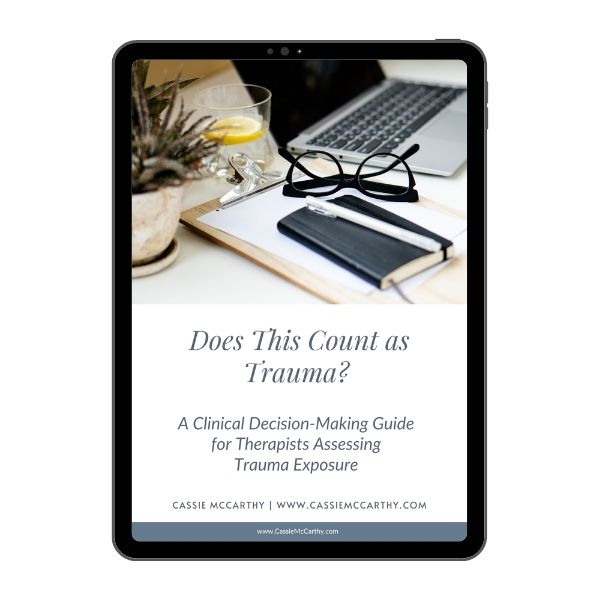
I offer a clinician resource titled Does This Count As Trauma: A Clinical Decision Making Guide For Therapists Assessing Trauma Exposure. It supports identification of real or threatened harm in cases where relational conditioning shaped behavior without overt violence.
Better definitions lead to better treatment.
You Were Adapting, Not Failing
Avoiding conflict.
Keeping everyone comfortable.
Trying to do everything perfectly.
These were not random traits.
They were attempts to stay safe.
The fact that they are now exhausting does not mean they were always wrong.
It means the context changed.
Trauma Therapy For Women In MA, IL, VA, VT, And FL
If you live in Massachusetts, Illinois, Virginia, Vermont, or Florida, I offer trauma-focused therapy for women struggling with chronic anxiety, people pleasing, perfectionism, and fear of conflict.
You do not have to eliminate these patterns through willpower.
When relational threat is understood accurately, your nervous system can learn new rules.
And peacekeeping can become choice rather than survival.