

Many women come into therapy carrying a quiet, persistent question.
“Why didn’t I say no?”
That question sounds reasonable. It sounds responsible. And it keeps people stuck.
It assumes that consent is primarily about verbal refusal. It assumes that if you did not object loudly or clearly enough, then agreement must have been present. It places the burden entirely on the person who was under pressure, rather than on the conditions they were responding to.
Clinically, that is not how consent works.
Consent is not determined by silence.
Consent is not determined by endurance.
Consent is not determined by what you managed to tolerate.
Consent is determined by choice.
And when choice is constrained, consent is compromised.
What Consent Actually Means
Consent is an enthusiastic yes.
That does not mean excitement or eagerness. It means internal willingness that is freely given, expressed without pressure, and chosen without fear of consequence.
For consent to exist, a person must be able to choose yes or no. Both options must be viable. Both options must be safe.
When that freedom is missing, compliance replaces consent.
The Three Rules Of Consent
Consent is often treated as confusing or subjective, but clinically it is not. In my work, consent follows three clear rules.
1. Consent Requires An Enthusiastic Yes
Consent requires a clear yes, expressed both internally and externally.
Not a reluctant yes.
Not a pressured yes.
Not silence.
Not freezing.
Not “just getting through it.”
Agreement that comes from endurance or self-protection is not consent. It is survival.
2. Consent Is Opt-In, Not Opt-Out
Consent must be actively given. It is not assumed.
Access to someone’s body is never the default that must be revoked. Permission must be requested and granted.
This is where many coercive experiences get misinterpreted. When consent is treated as opt-out, freeze responses, shutdown, and quiet compliance are mistakenly read as agreement.
Consent requires the presence of a yes, not the absence of a no.
3. If You Cannot Say No, You Cannot Give A Fully Unrestricted Yes
Consent cannot exist if refusal is not a viable option.
If saying no would lead to anger, withdrawal, pressure, retaliation, instability, or fear, then consent is already compromised.
This includes situations involving power differences, emotional dependence, financial reliance, relational threat, or persistent pressure that erodes resistance over time.
When refusal carries consequences, agreement is constrained.
And when agreement is constrained, consent is not present.
What Coercion Actually Is
Coercion is not a gray area. It is defined.
Sexual coercion is sexual activity without free and voluntary agreement.
It involves pressuring, manipulating, or forcing someone into sexual activity without their full, unrestricted consent. What distinguishes coercion is not severity, but method. Coercion relies on non-physical tactics rather than overt force.
These tactics can include repeated requests after a no, emotional pressure, guilt, silence, withdrawal, misuse of authority, exploitation of vulnerability, or implied threats such as ending a relationship or withholding affection.
Coercion is a form of sexual violence because it obtains sexual contact under duress, not desire.
This is true even when there is no weapon, no visible injury, and no moment that looks dramatic from the outside.

The Absence Of No Is Not A Yes
Many people believe consent existed because they did not say no.
But silence is not agreement when saying no does not feel safe.
When the nervous system perceives that refusal will lead to loss, conflict, punishment, or abandonment, it adapts. It prioritizes safety over preference. That adaptation often looks like freezing, complying, or going along with something you do not want.
This is why so many women say:
“I didn’t want it, but I didn’t stop it.”
“I went along with it to make it end.”
“It felt easier to give in.”
These statements are not evidence of consent. They are evidence of constrained choice.
The clinical question is not “Why didn’t you say no?”
The clinical question is “What made saying no feel impossible?”
The Impacts Of Coercion And Control
Coercion does not end when the interaction ends.
Experiences of pressure and control often lead to long-term effects, including confusion about responsibility, guilt when setting boundaries, difficulty trusting your own judgment, sexual distress, emotional numbness, anxiety, and shutdown responses.
These effects are not signs of weakness. They are predictable responses to situations where agency was compromised.
When coercion is ongoing or repeated, the nervous system learns that asserting needs is unsafe. Over time, self-trust erodes. Compliance becomes automatic. Desire becomes tangled with fear.
Many people do not recognize what happened as coercion because it did not match the stories they were taught about sexual harm. But trauma is not defined by how violent something looks from the outside. It is defined by threat, powerlessness, and nervous system response.
If You Are Unsure How To Make Sense Of What You Experienced
Uncertainty is common after coercion. Not because nothing happened, but because the language to describe it was missing.
If you find yourself wondering whether what you went through counts, that uncertainty often reflects a lack of accurate frameworks, not a lack of harm.
I offer a client-centered resource called Does This Count As Trauma: A Checklist For Women Who Wonder If What They Went Through Was “Bad Enough” To Be Called Trauma. It helps you assess experiences based on pressure, threat, and power rather than blame or comparison.
The goal is not to force a label. It is to restore clarity.

How I Work With Consent Erosion And Coercion In Therapy
In therapy, coercion is not treated as a communication failure or a boundary mistake.
It is treated as a disruption of agency.
Using evidence-based, cognitively informed trauma treatment, including Cognitive Processing Therapy, we examine how beliefs about consent, responsibility, and self-trust were formed under constrained conditions.
We look closely at:
- Whether refusal was a viable option
- What consequences were perceived
- How pressure shaped decision-making
- Where responsibility became misassigned
This work is not about excusing harm or removing accountability where it belongs. It is about restoring accuracy.
When responsibility is misassigned inward, therapy focuses on recalibrating those beliefs so they match reality. As accuracy returns, self-blame loosens and agency rebuilds.
For Therapists Seeking Clinical Clarity
For clinicians, consent and coercion are often where uncertainty enters the room.
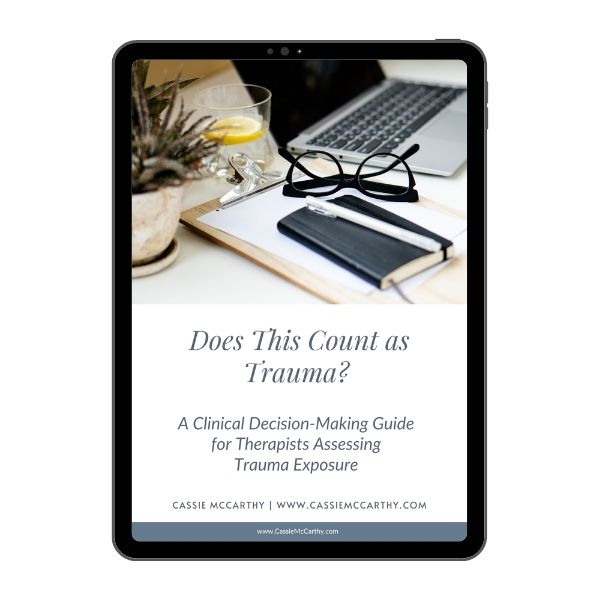
I offer a clinician resource titled Does This Count As Trauma: A Clinical Decision Making Guide For Therapists Assessing Trauma Exposure. It provides a clear framework for identifying real or threatened harm in cases involving pressure, power imbalance, and relational coercion, without relying on legal thresholds or forcing labels.
The goal is clinical clarity, not escalation.
Healing Begins With Accurate Definitions
Healing does not begin with deciding how you should feel. It begins with understanding whether consent was actually possible.
When the absence of no is no longer mistaken for yes, confusion gives way to clarity. Self-blame softens. Agency becomes available again.
Trauma Therapy For Women In MA, IL, VA, VT, And FL
If you live in Massachusetts, Illinois, Virginia, Vermont, or Florida, I offer trauma-focused therapy for women impacted by coercion, pressure, and consent erosion.
You do not need certainty to begin therapy. You only need to know that something did not feel freely chosen and that it continues to affect you.
Consent requires freedom.
And when freedom was missing, your response makes sense.