

Many women describe themselves as anxious in relationships.
They say they overthink texts.
They replay conversations.
They monitor tone.
They feel a surge of fear when something feels “off.”
They assume this means they are insecure or overly sensitive.
Often, they are told the same thing.
Clinically, that interpretation is frequently incomplete.
What looks like anxiety in relationships is often hypervigilance.
And hypervigilance is a trauma response.
Hypervigilance Is Not The Same As Anxiety
Anxiety is a general sense of worry about potential future events.
Hypervigilance is a trauma symptom.
Hypervigilance develops when the nervous system has learned that safety depends on detecting subtle shifts in the environment.
It is not random fear. It is scanning for threat.
When someone has experienced relational trauma, coercion, gaslighting, volatility, or emotional instability, tracking other people becomes protective.
The nervous system adapts by becoming highly attuned to changes in tone, mood, and behavior.
This adaptation can look like anxiety.
But its function is safety-seeking.
Relational Scanning And “Checking The Weather”
Many women describe what I call relational scanning.
You are constantly checking the emotional weather.
Is he quiet because he is tired or because he is upset?
Was that pause normal or meaningful?
Did his tone change?
Is something wrong?
This constant monitoring is exhausting.
But it did not develop without reason.
If at some point in your life someone’s mood predicted whether you were safe, loved, criticized, ignored, or pressured, your nervous system learned to track those cues.
When reactions were volatile, unpredictable, or punishing, scanning became necessary.
Hypervigilance is what happens when your body does not want to be caught off guard again.
Tracking Others As A Safety Strategy
When resistance was punished or unpredictability was common, early detection became protective.
If you could sense a shift before escalation, you could adjust.
You could soften your tone.
You could agree.
You could avoid a topic.
You could leave the room.
These micro-adjustments reduce conflict and potential harm.
Over time, this becomes automatic.
You are not consciously deciding to scan. Your nervous system is doing it for you.
What feels like overthinking is often trauma-informed pattern recognition.

Why Hypervigilance Gets Misdiagnosed As Anxiety
Hypervigilance is frequently labeled as anxiety because both involve heightened arousal.
But the origins are different.
Anxiety is anticipatory fear about uncertain outcomes.
Hypervigilance is threat monitoring based on learned experience.
When clients present with chronic relationship worry, many clinicians focus on attachment style or generalized anxiety without assessing for relational trauma.
If someone learned that subtle mood shifts preceded harm, their monitoring is not irrational.
It is conditioned.
Without addressing the original conditioning, attempts to reduce anxiety alone often fail.
The Cost Of Chronic Relational Monitoring
Hypervigilance feels necessary, but it comes at a cost.
- You struggle to relax.
- You second guess your interpretations.
- You assume negative intent quickly.
- You feel responsible for managing the emotional climate.
Because you are constantly scanning, your nervous system rarely settles.
Even neutral situations can feel loaded.
This can lead to shame.
“I am too much.”
“I ruin things by overthinking.”
“I can’t just enjoy my relationship.”
These beliefs ignore the context in which hypervigilance developed.
When Hypervigilance Continues In Safe Relationships
One of the most confusing aspects of hypervigilance is that it often persists even when current partners are not volatile.
Your body does not immediately update just because circumstances changed.
If relational threat was present in the past, the nervous system may continue scanning in the present.
This does not mean your current partner is dangerous.
It means your nervous system has not recalibrated yet.
Reducing hypervigilance requires safety and accurate reinterpretation of cues.
It cannot be forced through reassurance alone.

If You Are Wondering Whether Trauma Shaped Your Relationship Anxiety
Many women do not connect hypervigilance to trauma because there was no overt violence.
But threat does not require physical force.
If unpredictability, manipulation, coercion, or emotional volatility were present, your nervous system adapted.
If you are unsure whether past experiences shaped your relational anxiety, I offer a client-centered resource called Does This Count As Trauma: A Checklist For Women Who Wonder If What They Went Through Was “Bad Enough” To Be Called Trauma. It helps identify where real or threatened harm influenced how you experience safety in relationships.
Understanding context often reduces shame.
How I Treat Hypervigilance In Trauma Therapy
In trauma therapy, hypervigilance is not treated as overreacting.
It is treated as information.
Using Cognitive Processing Therapy skills, we identify beliefs that formed around safety in relationships, such as:
- “I have to monitor constantly to stay safe.”
- “If I miss a sign, something bad will happen.”
- “Other people’s moods determine my safety.”
We evaluate these beliefs for accuracy based on the context in which they formed.
We examine whether current cues truly signal threat or whether they are reminders of past dynamics.
As beliefs become more accurate, the nervous system recalibrates.
Hypervigilance decreases not because you suppress it, but because your body no longer perceives constant danger.
For Therapists Assessing Relationship Anxiety
For clinicians, chronic relational anxiety should prompt assessment for relational threat monitoring.
If clients are constantly scanning partners’ moods, evaluating for past coercion, volatility, or power imbalance is essential.
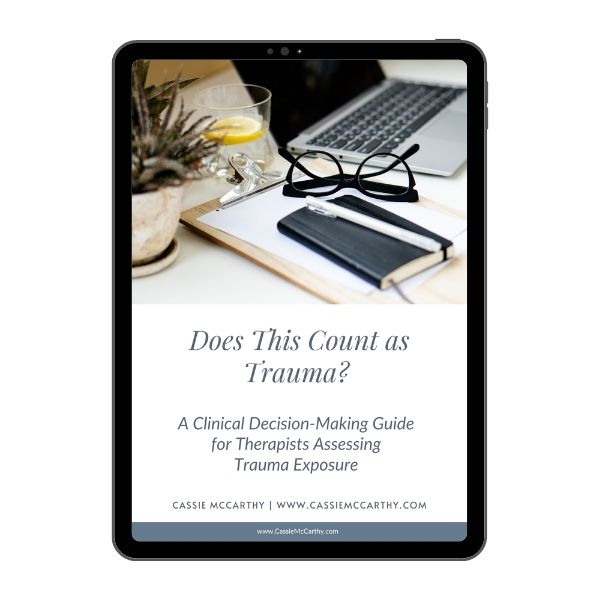
I offer a clinician resource titled Does This Count As Trauma: A Clinical Decision Making Guide For Therapists Assessing Trauma Exposure. It supports more accurate identification of threat-based adaptations in relational contexts.
Accurate formulation leads to effective intervention.
Hypervigilance Is A Survival Skill That Outlived Its Context
You are not irrational for scanning.
You learned that missing a signal had consequences.
Your nervous system adapted accordingly.
The goal is not to shame that adaptation.
The goal is to update it.
Trauma Therapy For Women In MA, IL, VA, VT, And FL
If you live in Massachusetts, Illinois, Virginia, Vermont, or Florida, I offer trauma-focused therapy for women struggling with chronic relationship anxiety, hypervigilance, and difficulty relaxing with partners.
You do not need to stop scanning through willpower.
When the original threat is understood and beliefs are recalibrated, your nervous system can learn that safety does not require constant monitoring.
Hypervigilance once protected you.
It does not have to run your relationships now.