

Many women carry a single sentence that feels impossible to undo.
“Why didn’t I do something?”
They replay the moment. They imagine fighting harder, speaking louder, leaving sooner. They assume that if they had really wanted to stop it, they would have.
This belief is reinforced culturally.
If you did not scream, it must not have been serious.
If you did not say no clearly, it must have been consent.
If you did not leave, you must have chosen to stay.
These assumptions are not clinically accurate.
Freeze is a survival response.
It is not a failure to act.
What The Freeze Response Actually Is
The nervous system has multiple survival pathways.
Fight.
Flight.
Freeze.
Appeasement.
Freeze occurs when escape feels impossible or when attempts to fight or flee are perceived as increasing risk.
In those moments, the brain evaluates options rapidly and unconsciously. If resisting is likely to escalate harm and leaving is not available, the body shifts into immobility.
This shift is automatic.
It is not chosen.
It is not strategic in a conscious way.
It is reflexive survival under constrained choice.
Why Freeze Is Used When Other Options Feel Unsafe
Many people assume freeze is passivity.
Clinically, it is an adaptive calculation.
If fighting would provoke retaliation.
If fleeing would increase danger.
If speaking up would escalate the situation.
The nervous system selects the response most likely to reduce harm.
Freeze reduces movement. It reduces sound. It reduces resistance.
It can lower the chance of further escalation.
In that moment, freeze may have been the safest available option.
It was not weakness.
It was your body attempting to protect you.
What Happens In The Body During Freeze
When freeze activates, the body undergoes chemical changes.
Mobility decreases.
Speech can become difficult or impossible.
Muscles may feel heavy or numb.
Time perception can shift.
People often describe feeling stuck, paralyzed, or unable to respond even though they wanted to.
This is not indecision.
It is neurobiology.
Once freeze occurs, mobility is chemically inhibited. The body is not waiting for permission. It is in a state of immobilization designed to reduce threat.
Expecting yourself to override that state is like expecting yourself to will away a reflex.
It is not how the nervous system works.

Freeze, Compliance, And Appeasement
Freeze is often followed by compliance or appeasement.
When movement and speech are limited, going along with what is happening can feel like the only viable option.
This is especially true in situations involving power imbalance, coercion, or relational threat.
If saying no would escalate harm, silence or compliance may feel safer.
Later, when the threat has passed, people judge themselves harshly.
“I should have fought.”
“I should have said no.”
“I should have left.”
These judgments ignore the conditions present at the time.
Under constrained choice, survival responses replace preference.
Why Society Misinterprets Freeze
Society often equates resistance with validity.
If you did not visibly resist, people assume you consented.
That is not how consent works.
Consent requires an enthusiastic yes.
Silence is not consent.
Immobility is not consent.
Compliance under threat is not consent.
The absence of a no does not equal a yes.
When freeze prevents speech or movement, it cannot logically be interpreted as agreement.
The nervous system was protecting you.
The Negative Beliefs That Follow Freeze
After a freeze response, many women develop painful beliefs about themselves.
“I am weak.”
“I must have wanted it.”
“I failed to protect myself.”
“I cannot trust my instincts.”
These beliefs are not evidence.
They are attempts to make sense of something confusing.
Self-blame often develops because it feels more controllable than acknowledging powerlessness.
If it was your fault, then you can prevent it next time.
But freeze was not a moral failure.
It was a protective response.
Survival Under Constrained Choice
When options are limited, survival responses dominate.
This is what I refer to as survival under constrained choice.
Choice was not fully available.
Risk was present.
The nervous system prioritized safety.
Evaluating your behavior outside of that context creates distorted conclusions.
Context restores accuracy.

If You Are Questioning Your Freeze Response
Many women struggle with freeze because they do not have a framework for understanding it.
They assume it means the experience was not serious.
Or they assume it means they are incapable.
If you are unsure whether what you experienced involved real or threatened harm, I offer a client-centered resource called Does This Count As Trauma: A Checklist For Women Who Wonder If What They Went Through Was “Bad Enough” To Be Called Trauma. It helps evaluate experiences based on threat and powerlessness rather than force or visible resistance.
Clarity often reduces shame.
How I Work With Violation In Trauma Therapy
In trauma therapy, freeze is not treated as avoidance.
It is treated as information.
Using Cognitive Processing Therapy skills, we identify beliefs that formed after the event, particularly beliefs about responsibility and strength.
We examine:
- What options were realistically available
- What risks were perceived
- Whether resistance would have increased harm
- How responsibility has been misassigned
This work restores accuracy.
As beliefs become more accurate, shame decreases. Self-trust begins to rebuild.
The goal is not to convince you that nothing happened.
It is to help you understand that your body responded in the way most likely to reduce harm under those conditions.
For Therapists Assessing Freeze Responses
For clinicians, freeze is frequently misinterpreted as passivity or complicity.
Accurate assessment requires evaluating threat, power imbalance, and constrained choice rather than relying on visible resistance.
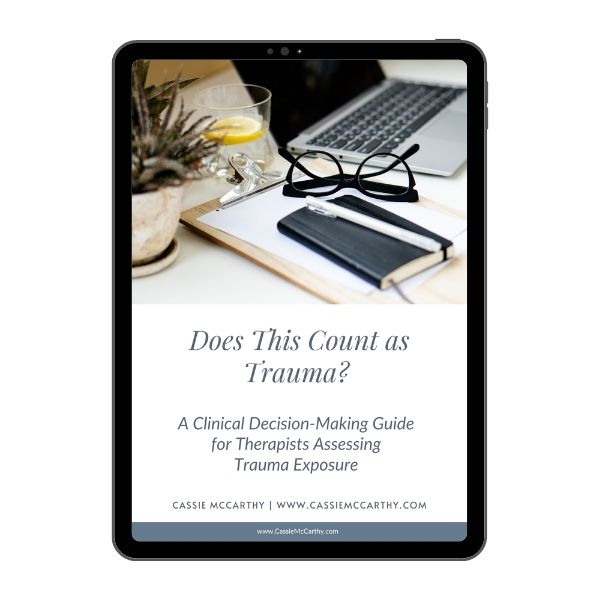
I offer a clinician resource titled Does This Count As Trauma: A Clinical Decision Making Guide For Therapists Assessing Trauma Exposure. It supports clearer identification of real or threatened harm when clients present with freeze, compliance, or appeasement.
Accurate definitions improve treatment.
Looking for Deeper Resources?
My course, When Consent Is Compromised: Applied Clinical Skills for Treating Sexual Coercion is available now. 8.5 continuing education hours* for navigating sexual trauma’s gray areas
Freeze Was A Success, Not A Failure
If freeze reduced escalation.
If freeze prevented further harm.
If freeze helped you survive the moment.
Then freeze worked.
It may not feel heroic. It may not look strong.
But it was your nervous system doing exactly what it was designed to do under threat.
Understanding that changes the story.
Trauma Therapy For Women In MA, IL, VA, VT, And FL
If you live in Massachusetts, Illinois, Virginia, Vermont, or Florida, I offer trauma-focused therapy for women struggling with shame, self-blame, or confusion after a freeze response.
You do not need to rewrite the past.
You need to understand it accurately.
Freeze was not your failure.
It was your body protecting you.