

Many women minimize their own experiences with one sentence.
“But he’s a good guy.”
He was not violent.
He did not threaten you.
He did not look dangerous.
And because he was not scary, you assume what happened cannot be that serious.
This is where confusion begins.
We tend to equate trauma with force. We picture visible injury, explicit threats, or physical domination. When harm does not look like that, we downgrade it.
Clinically, that is inaccurate.
Trauma is not defined by force. It is defined by threat and powerlessness.
Violation can be just as destabilizing as overt violence. It simply operates differently.
Trauma Is Defined By Threat And Powerlessness, Not Force
The nervous system does not require physical violence to register harm.
It responds to perceived threat, loss of control, and inability to stop what is happening.
If you felt trapped, pressured, overpowered emotionally, or unable to refuse without consequence, your nervous system registered threat.
That registration is what drives trauma responses.
Force is one way to remove choice. It is not the only way.
Coercion, manipulation, guilt, emotional withdrawal, or misuse of power can remove choice just as effectively.
When choice is removed, agency is disrupted.
That disruption is what makes violation harmful.
Why Coercion Is Most Confusing When The Person Is Not Violent
When violation comes from someone who appears kind, stable, or socially acceptable, the harm is harder to name.
If he is generous in other areas.
If he does not yell.
If he is well regarded.
You may question your own reaction.
You may think:
“Maybe I am overreacting.”
“Maybe I misunderstood.”
“Maybe this is just how relationships are.”
This confusion is common when coercion is relational rather than forceful.
Coercion does not require anger. It does not require physical strength. It often operates through persistence, expectation, obligation, or subtle power imbalance.
When harm comes from someone who does not fit the stereotype of a perpetrator, self-doubt increases.
Violation Disrupts Agency
Agency is your sense that you can act in alignment with your needs and values.
Violation disrupts that sense.
When your no is ignored.
When your hesitation is overridden.
When your comfort is secondary.
You learn something about your place in the interaction.
You learn that your needs are negotiable.
You learn that your boundaries are flexible.
You learn that maintaining stability may require self-suppression.
These lessons do not disappear when the interaction ends.
They reshape how you experience yourself in relationships.

Why Violation Feels So Destabilizing
Overt violence is easier to validate socially.
There is often visible evidence. There is cultural language for it. There is recognition that harm occurred.
Violation, particularly when it is covert or relational, rarely receives that validation.
When no one names it.
When the person appears normal.
When others minimize it.
You are left alone with your reaction.
This lack of acknowledgment reinforces confusion.
You may feel distress but have no external confirmation that it makes sense. That isolation deepens the harm.
It can lead to self-blame, second guessing, and erosion of self-trust.
The covert nature of violation does not make it less harmful.
It often makes it more destabilizing because it remains unrecognized.
“But He’s A Good Guy” And The Problem Of Character
Many women struggle because they are evaluating harm based on character rather than behavior.
Someone can be generous in one context and coercive in another.
Someone can be socially respected and still violate boundaries privately.
Harm is not erased by likability.
The nervous system does not assess reputation. It assesses threat.
If you felt powerless, pressured, or unable to stop what was happening, your body responded accordingly.
The Consequences Of Unnamed Violation
When violation is minimized or dismissed, the effects often include:
- Confusion about whether harm occurred
- Difficulty trusting your perception
- Boundary guilt
- Sexual distress
- Anxiety in relationships
- Increased self-blame
These are not exaggerated reactions.
They are predictable outcomes when agency is disrupted without acknowledgment.
Without accurate language, people often turn inward for explanations.
“If it was not violent, it must be my fault.”
That conclusion is common and incorrect.

If You Are Unsure Whether What Happened Was Serious
Many women struggle not because nothing happened, but because what happened did not fit the narrative of violence they were taught.
If you are uncertain whether your experience counts, that uncertainty does not mean it was insignificant.
It often means you have not been given a framework that defines trauma by threat and powerlessness rather than force.
I offer a client-centered resource called Does This Count As Trauma: A Checklist For Women Who Wonder If What They Went Through Was “Bad Enough” To Be Called Trauma. It helps evaluate experiences based on freedom, pressure, and agency rather than visible violence.
The goal is clarity, not escalation.
How I Work With Violation In Trauma Therapy
In trauma therapy, violation is not treated as a misunderstanding.
It is treated as an agency injury.
Using Cognitive Processing Therapy skills, we examine beliefs that developed after the experience, including:
- “It was not that bad.”
- “I should not feel this way.”
- “I am overreacting.”
- “If he was not violent, it does not count.”
These beliefs are evaluated for accuracy based on the actual conditions present at the time.
We identify where choice was constrained. We clarify where responsibility lies. We restore context.
As clarity increases, self-blame decreases. Self-trust begins to rebuild.
The goal is not to amplify harm. It is to name it accurately so your nervous system can recalibrate.
For Therapists Assessing Relational Coercion
For clinicians, violation without overt violence is one of the most commonly misclassified forms of trauma exposure.
When harm is evaluated based on force rather than threat and powerlessness, clients are often underdiagnosed or misdirected in treatment.
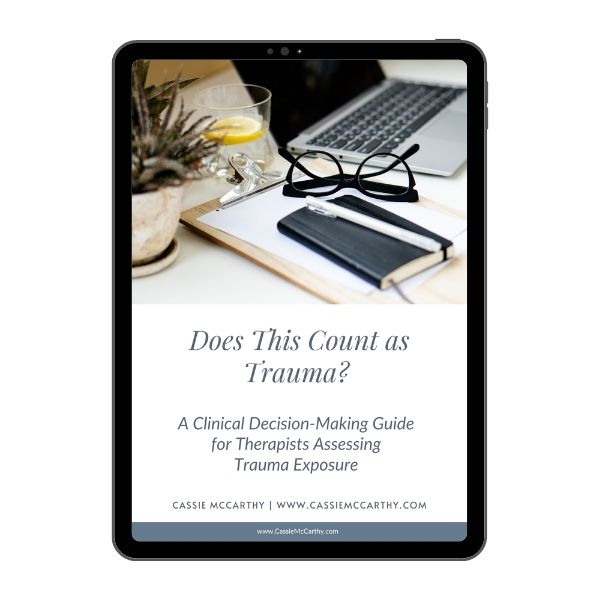
I offer a clinician resource titled Does This Count As Trauma: A Clinical Decision Making Guide For Therapists Assessing Trauma Exposure. It provides a structured framework for identifying real or threatened harm in cases involving relational coercion and power imbalance.
Accurate definition changes intervention.
Naming Violation Restores Stability
Violation is harmful not because it was dramatic, but because it disrupted agency.
When you understand that trauma is defined by threat and powerlessness rather than force, confusion decreases.
You do not need visible violence to justify your reaction.
Your nervous system responded to what felt unsafe.
And that response makes sense.
Trauma Therapy For Women In MA, IL, VA, VT, And FL
If you live in Massachusetts, Illinois, Virginia, Vermont, or Florida, I offer trauma-focused therapy for women who are struggling with confusion, self-doubt, or relational anxiety after coercion or violation.
You do not need to prove that it was violent to deserve help.
If your agency was compromised, that is enough.
Understanding that distinction can change everything.