

Many women say the same thing in different ways.
“I don’t trust myself anymore.”
“I second guess everything.”
“I feel anxious all the time because I don’t know if I’m overreacting.”
They often assume this means their judgment is flawed.
Clinically, that is usually not true.
Coercion, gaslighting, and manipulation erode self-trust. They do not erase intelligence. They do not remove discernment. They distort your relationship with your own perception.
Understanding that difference is the beginning of repair.
How Coercion And Gaslighting Erode Self-Trust
Self-trust develops when your perceptions are confirmed by experience.
You feel something.
You respond to it.
The response maintains safety.
Over time, your nervous system learns that your internal signals are reliable.
Coercion interrupts that process.
When you are pressured into going along with something you do not want, your internal signal says no, but your external behavior says yes. That mismatch creates confusion.
Gaslighting deepens the fracture.
When someone tells you that what you felt did not happen, was not serious, or was your fault, your perception becomes destabilized.
Manipulation compounds the effect.
When affection, approval, or stability are tied to compliance, you learn to override your instincts in order to maintain connection.
Over time, your nervous system stops trusting your signals.
Not because they were wrong.
Because they were not allowed to matter.
Why Losing Self-Trust Creates Chronic Anxiety
When self-trust is compromised, the world feels unpredictable.
If you cannot rely on your own judgment, every decision feels risky.
Should I speak up?
Am I overreacting?
Is this normal?
Am I misreading this?
This creates chronic anxiety and overwhelm.
When you do not trust your internal signals, everything feels potentially harmful because you no longer feel equipped to detect threat accurately.
The anxiety is not random.
It is the nervous system trying to compensate for lost certainty.
The Difference Between Judgment And Self-Trust
Judgment is your ability to evaluate situations.
Self-trust is your belief that your evaluations are valid.
Trauma does not typically destroy judgment.
It disrupts confidence in judgment.
After coercion or manipulation, many women review past experiences and conclude they were naïve or foolish.
But when you examine those situations carefully, what you often find is constrained choice, pressure, fear of consequences, or incomplete information.
The issue was not intellectual failure.
It was context.
When context is missing from the story, self-trust collapses.

Why You Second Guess Yourself Now
Second guessing is common after relational trauma.
You learned that asserting your perception could lead to:
- Conflict
- Withdrawal
- Punishment
- Being told you were wrong
- Being told you were selfish or dramatic
Your nervous system adapted by becoming hypervigilant and self-correcting.
Instead of asking, “Is this safe?” it began asking, “How will this be received?”
That shift moves authority outward.
Rebuilding self-trust requires bringing it back inward.

If You Are Wondering Whether Trauma Shaped Your Self-Doubt
Many women do not immediately connect self-trust erosion to trauma because there was no overt violence.
If your experiences involved pressure, manipulation, gaslighting, or power imbalance rather than physical force, it may not have been labeled as trauma.
But threat does not require a weapon.
If you are unsure whether past experiences shaped your anxiety and self-doubt, I offer a client-centered resource called Does This Count As Trauma: A Checklist For Women Who Wonder If What They Went Through Was “Bad Enough” To Be Called Trauma. It helps identify where real or threatened harm, pressure, or loss of agency may have shaped your nervous system.
Clarity is often the first step toward restoring trust in yourself.
Rebuilding Self-Trust Requires Safety First
Self-trust does not improve through willpower.
It improves through safety.
When the nervous system no longer feels chronically threatened, internal signals become easier to access and evaluate.
Improving self-trust follows a sequence.
First, safety must be established.
Then, experiences of effective boundary setting and decision making can be reviewed accurately.
Then, confidence begins to rebuild.
Without safety, every reflection turns into self-criticism.
With safety, reflection becomes information.
This is why trauma therapy is often necessary. If your nervous system is still operating as if threat is ongoing, attempts to “just trust yourself” will feel impossible.
How I Rebuild Self-Trust In Trauma Therapy
In trauma therapy, rebuilding self-trust is not about positive thinking.
It is about accuracy.
Using Cognitive Processing Therapy skills, we identify beliefs that developed under coercion or manipulation, such as:
- “I can’t trust my instincts.”
- “If I were smarter, this wouldn’t have happened.”
- “I should have known better.”
- “My perception is unreliable.”
We examine these beliefs in context.
- What information did you have at the time?
- What pressures were present?
- What risks felt real?
- What choices were realistically available?
When context is restored, responsibility becomes more accurately distributed.
As beliefs become more accurate, anxiety decreases.
Over time, you begin to notice something important.
You were not incapable.
You were adapting.
And adaptation can be updated.
For Therapists Working With Self-Trust Erosion
When clients present with chronic anxiety, indecision, and self-doubt, the formulation often centers on self-esteem.
It is often more accurate to assess for coercion, gaslighting, or relational trauma.
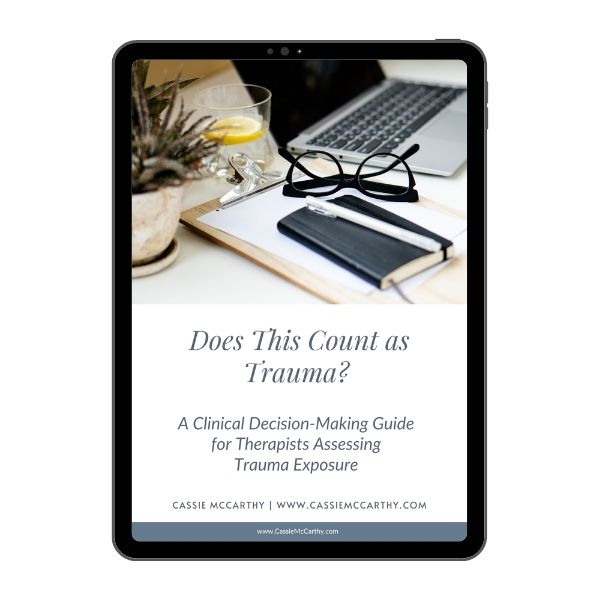
I offer a clinician resource titled Does This Count As Trauma: A Clinical Decision Making Guide For Therapists Assessing Trauma Exposure. It supports clearer identification of real or threatened harm in cases where manipulation and power imbalance eroded agency without overt violence.
Accurate assessment improves treatment.
Self-Trust Returns When Reality Is Understood Clearly
Self-trust does not return because you convince yourself you are confident.
It returns when you understand what actually happened.
When you see that your nervous system was responding to pressure, not failing.
When you recognize that your instincts were overridden, not absent.
When you can review the past without collapsing into blame.
That is not denial.
It is accuracy.
And accuracy is stabilizing.
Trauma Therapy For Women In MA, IL, VA, VT, And FL
If you live in Massachusetts, Illinois, Virginia, Vermont, or Florida, I offer trauma-focused therapy for women struggling with chronic anxiety, second guessing, and loss of self-trust after coercion, gaslighting, or manipulation.
You do not need to rebuild trust in yourself alone.
When safety is restored and beliefs are recalibrated, self-trust becomes possible again.
Not because you changed who you are.
But because you understand what happened.