

Many women describe the same confusing experience during sex.
Their body is there, but they are not.
They feel distant. Foggy. Numb. Like they are watching from the outside or waiting for it to be over. Sometimes it happens suddenly. Sometimes it creeps in quietly. Often it brings shame or self-criticism afterward.
“I should be more present.”
“Why can’t I stay connected?”
“Something must be wrong with me.”
This reaction is often misunderstood as lack of desire, lack of attraction, or relationship dissatisfaction.
Clinically, it is often none of those things.
Checking out during sex is frequently a dissociative safety response.
What Is Dissociation
Dissociation is the nervous system’s way of reducing awareness when something feels overwhelming, unsafe, or internally conflicting.
It is not something you choose. It happens automatically when staying fully present does not feel safe.
During sex, dissociation often shows up as checking out, going numb, or feeling emotionally distant from what is happening. Your body may still be participating, but your attention pulls away. Sensation dulls. Time may feel fuzzy.
This response develops when being present has been associated with pressure, fear, or loss of choice. Dissociation allows the body to endure without escalating risk.
It is a protective response, not a defect.
Dissociation Is Not Disinterest. It Is Protection.
Dissociation is the nervous system’s way of reducing awareness when something feels overwhelming, threatening, or internally conflicting.
It is not something you decide to do. It happens automatically when the brain perceives that staying fully present is unsafe.
During sex, dissociation often shows up as:
- Feeling numb or disconnected from sensation
- Losing track of time
- Mentally drifting away
- Feeling emotionally flat or distant
- Going through the motions without internal engagement
These responses are not failures of intimacy. They are protective adaptations.
They develop when sex has been linked to pressure, obligation, fear, or violation.
Why The Body “Leaves The Room” During Sex
The nervous system does not respond only to what is happening now. It responds to what sex has meant over time.
If sex has ever been associated with distress, threat, or loss of agency, the body learns that full presence is risky.
This can happen after overt sexual harm, but it also happens in quieter ways.
For example:
- Sex felt expected rather than chosen
- Saying no led to conflict, withdrawal, or pressure
- Going along felt safer than refusing
- Sex was used to maintain peace or connection

In these contexts, dissociation becomes a way to endure without escalating risk.
Checking out allows the body to stay compliant while protecting the mind.
When Sex Carries Conflicting Meanings
Dissociation is especially common when sex holds conflicting meanings.
You may want closeness but not the act itself.
You may care about your partner but feel pressure to meet expectations.
You may believe sex is an obligation in a relationship even when your body disagrees.
When desire and obligation collide, the nervous system looks for an exit.
That exit is often numbness.
Sex becomes something to get through rather than something to participate in.
Dissociation After Coercion Or Pressure
After experiences of sexual coercion or control, dissociation can become the body’s default response to sexual cues.
This is not because the body is broken. It is because it learned that being present did not lead to safety.
If sex once required enduring pressure, ignoring discomfort, or complying to avoid consequences, dissociation made that possible.
Later, even in safer contexts, the body may continue using the same strategy.
This is how dissociation becomes generalized.
Why Sex Can Feel Stressful Before It Even Begins
Many women notice stress before sex even starts.
Anticipation brings tension. Thoughts race. The body tightens. Desire shuts down.
This is not anxiety about performance. It is the nervous system scanning for threat.
Both historical and present context matter.
Past experiences of coercion, unwanted sex, or violation can prime the body to expect danger. Present dynamics like feeling obligated, fearing a partner’s reaction, or worrying about conflict can reinforce that expectation.
This is where the dual control model of sexual response helps explain what is happening.
Sexual arousal is influenced by excitatory systems that move us toward sex and inhibitory systems that pull us away when something feels unsafe.
When inhibition is strong, dissociation often follows.
This is not a libido problem. It is a safety response working as designed.
Why Pushing Yourself To Stay Present Does Not Work
Many women try to fix dissociation by forcing themselves to stay present.
They focus harder. They try to relax. They tell themselves they should be enjoying it.
This usually makes things worse.
Dissociation is not resolved by effort. It is resolved by safety.
When the nervous system does not feel safe, presence is not possible. Trying to override that response often reinforces the belief that your needs do not matter.
Healing does not come from pushing through. It comes from understanding why dissociation developed.
If You Are Trying To Understand Why This Happens
Many women blame themselves for checking out because they do not have a framework for understanding dissociation.
They assume it means they are broken, uninterested, or incapable of intimacy.
If you find yourself wondering whether something from the past shaped how your body responds now, that curiosity is worth following.
I offer a client-centered resource called Does This Count As Trauma: A Checklist For Women Who Wonder If What They Went Through Was “Bad Enough” To Be Called Trauma. It helps identify experiences where pressure, threat, or loss of choice shaped your nervous system, even if there was no overt violence.
The goal is understanding, not labeling.

How I Work With Dissociation During Sex In Trauma Therapy
In trauma therapy, dissociation is not treated as avoidance or resistance.
It is treated as information.
Using Cognitive Processing Therapy skills, we examine the beliefs that developed around sex, safety, and obligation. These beliefs are evaluated for accuracy based on the conditions present when they formed.
Common beliefs include:
- “I have to go along to keep things stable”
- “Saying no will cause problems”
- “My discomfort matters less than their reaction”
Therapy focuses on restoring agency and choice, not forcing sexual engagement or sensation.
As safety and accuracy increase, dissociation often decreases naturally.
For Therapists Working With Sexual Dissociation
Sexual dissociation is frequently misinterpreted as low desire or relationship dissatisfaction.
For clinicians, accurate assessment of coercion, pressure, and constrained choice is essential when sexual numbness is present.
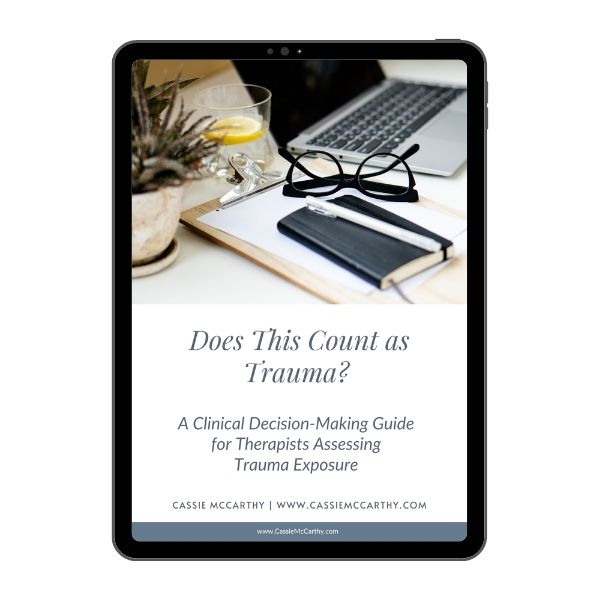
I offer a clinician resource titled Does This Count As Trauma: A Clinical Decision Making Guide For Therapists Assessing Trauma Exposure. It supports clearer identification of real or threatened harm when dissociation and sexual distress are the presenting concerns.
Dissociation Is A Response, Not A Defect
Checking out during sex does not mean you are broken.
It means your nervous system learned how to protect you when something did not feel safe.
When that protection is understood rather than fought, change becomes possible.
Trauma Therapy For Women In MA, IL, VA, VT, And FL
If you live in Massachusetts, Illinois, Virginia, Vermont, or Florida, I offer trauma-focused therapy for women who experience dissociation, numbness, or stress during sex.
You do not need to know exactly what caused it. You only need to know that your body learned this response for a reason.
Checking out was protective.
And protective responses can be understood, updated, and healed.