

Many people carry a quiet belief that sounds responsible on the surface.
“I should have known better.”
“I should have stopped it.”
“I shouldn’t have let it happen.”
This belief often shows up after experiences that were confusing, pressuring, or unwanted. Especially experiences that did not involve overt violence or a clear moment of danger.
And because it sounds rational, self-blame is rarely questioned. It feels like reflection. Like accountability. Like maturity.
But self-blame after trauma is not insight.
It is a survival strategy.
Understanding that distinction is often the first step toward healing.
The Misconception That Self-Blame Means You Missed Something
One of the most common misconceptions I hear in therapy is this:
“If I went along with it, it must be my fault.”
People assume that because they did not fight, flee, or forcefully object, they must have had more control than they actually did. They judge their past actions using information and safety they only had later.
This is not a failure of judgment. It is a failure of context.
Trauma is not defined by how something looks from the outside. It is defined by how threatened, trapped, or powerless a person felt in the moment. When choice is constrained by fear, pressure, or consequences, decisions are no longer freely made.
Self-blame emerges when the brain tries to rewrite a threatening experience into something that feels more controllable.
Why The Mind Chooses Self-Blame After Coercion Or Threat
Self-blame serves a psychological purpose.
If you believe what happened was your fault, then the world feels more predictable. If it was predictable, then it feels preventable. And if it feels preventable, then you do not have to face how little power you actually had at the time.
For the nervous system, that belief can feel safer than acknowledging vulnerability.
This is especially true in situations involving sexual coercion, relational pressure, or power imbalance. In these situations, saying no may have felt risky. Stopping the interaction may have carried emotional, relational, or practical consequences. Enduring may have felt like the safest option available.
Later, when the threat has passed, the mind turns inward and assigns blame. Not because it is accurate, but because it restores a sense of control.
The “I Should Have Known” Loop
Self-blame often becomes a loop rather than a single thought.
Something uncomfortable happens.
You do what you need to do to make it stop.
Later, your mind replays the event with judgment.
“I should have known.”
“I should have seen it coming.”
“I should not have let that happen.”
This loop is reinforced because it feels explanatory. But explanation is not the same as understanding.
The loop does not account for threat. It does not account for fear. It does not account for constrained choice.
It simply assigns fault.

How Self-Blame Slowly Erodes Self-Trust
Over time, repeated self-blame reshapes how people see themselves.
It becomes harder to trust your instincts.
Decisions feel fraught.
Boundaries feel guilt-inducing.
Confidence erodes quietly.
Many people begin to believe they are bad at reading situations, bad at protecting themselves, or bad at knowing what they want.
This is not because they lack intuition.
It is because their mind learned that blaming themselves felt safer than acknowledging how limited their options were.
When self-blame becomes habitual, it stops being about one event and becomes a story about who you are.
Self-Blame Is A Meaning-Making Outcome Of Trauma
In trauma psychology, self-blame is understood as a common meaning-making response. It is how the brain tries to organize an experience that involved threat, loss of agency, or powerlessness.
This is especially true when the trauma did not fit cultural stereotypes of what trauma is supposed to look like.
When there was no weapon.
When there was no physical injury.
When there was compliance instead of resistance.
In these cases, people often assume the harm must be minimal or self-inflicted. But trauma exposure is defined by real or threatened harm as perceived by the nervous system, not by visible force.
Self-blame fills the gap left by misunderstanding trauma.
A More Accurate Question To Ask
Instead of asking, “Why did I let it happen?” a more accurate question is:
“What felt at stake for me in that moment?”
What consequences were you trying to avoid?
What made resistance feel unsafe?
What did your body believe would happen if you said no?
These questions shift the focus from judgment to context. And context is where healing begins.
But, Does This Count?
When experiences do not fit cultural ideas of trauma, many women turn inward for explanations. Self-blame becomes the default because there is no clear way to assess threat, pressure, or choice.
If you find yourself wondering whether what you went through “counts,” that uncertainty is often about missing framework, not exaggeration.
I offer a short client checklist called Does This Count As Trauma: A Checklist For Women Who Wonder If What They Went Through Was “Bad Enough” To Be Called Trauma. It is designed to help you evaluate experiences based on threat and power rather than blame or comparison.
The goal is clarity, not labels.

How I Work With Self-Blame In Trauma Therapy
When self-blame is trauma-based, it usually is not solved by reassurance.
It is solved by skill.
In my work, I treat self-blame as a belief system that can be identified, tested, and updated using Cognitive Processing Therapy skills. That matters because self-blame is rarely just a feeling. It is usually a conclusion.
And the conclusion usually sounds like one of these:
- “I should have known.”
- “I let it happen.”
- “I put myself in that position.”
- “It was my job to stop it.”
CPT helps us slow that conclusion down and examine what it is made of.
Step One: We Name The Belief Clearly
Self-blame is often vague in people’s minds. It shows up as shame, tightness, nausea, or a quick thought that disappears. We make it specific and visible.
Not to intensify it. To work with it.
Instead of “I feel bad,” we identify the actual belief driving the emotion, such as:
- “I’m responsible for what happened.”
- “I should have prevented it.”
- “I’m weak for not stopping it.”
Step Two: We Separate Responsibility From Outcome
One of the biggest errors trauma creates is merging two different ideas:
- “Something bad happened”
- “Therefore I caused it”
CPT helps us separate what you were responsible for from what you were not responsible for.
Responsibility is about what you controlled.
Outcome is about what occurred.
Those are not the same thing, especially when choice was constrained by pressure, threat, or power imbalance.

Step Three: We Look For The Missing Context
Self-blame thrives on hindsight.
In CPT, we bring the moment back into full context. Not by rehashing every detail, but by identifying what was true at the time:
- What did you know then that you did not know later?
- What did you believe would happen if you resisted?
- What consequences felt likely?
- What options did you realistically have in that moment?
When people say “I let it happen,” what they often mean is, “I did what I needed to do to get through it.” CPT gives us the structure to name that accurately.
Step Four: We Practice More Accurate Thinking
This is where people often expect therapy to be inspirational. It is not.
It is precise.
We practice shifting from self-blame thoughts to beliefs that account for the actual conditions present, such as:
- “I did not cause someone else to pressure me.”
- “My options were limited, and I chose the safest one I could see.”
- “Free choice requires freedom to refuse.”
- “Compliance is not consent.”
These are not affirmations. They are corrections.
Step Five: We Rebuild Self-Trust Through Repetition
Self-blame does not disappear because you intellectually understand it. It changes when your mind has repeated practice updating it.
That is why CPT is effective. It gives people a way to work with their thoughts instead of being trapped inside them.
Over time, the goal is not to convince you that nothing happened.
The goal is to help you see what happened accurately, so you stop using self-blame as the price of feeling safe.
Why Letting Go Of Self-Blame Creates Hope
Letting go of self-blame does not mean pretending you had unlimited control. It means telling the truth about what it was like to be you in that moment.
When responsibility is placed accurately, something shifts.
Self-trust begins to return.
Boundaries feel less charged.
Decisions feel more grounded.
Healing is not about rewriting the past. It is about understanding it accurately so it no longer defines you.
Therapy For Trauma And Self-Blame
If you live in Massachusetts, Illinois, Virginia, Vermont, or Florida, I offer trauma-focused therapy for women who are struggling with self-blame, confusion, and the long-term effects of trauma that was never clearly named.
You do not need to be certain that what you experienced was trauma in order to seek help. You only need to be curious about why it still affects you.
Self-blame is not proof that you failed.
It is proof that your mind adapted to survive.
And survival responses can be understood, corrected, and healed.
If you would like support, you are welcome to reach out to schedule a consultation.
For Therapists Assessing Trauma Exposure
When clients present with self-blame, minimization, or confusion about responsibility, the issue is often not insight. It is misclassified trauma exposure.
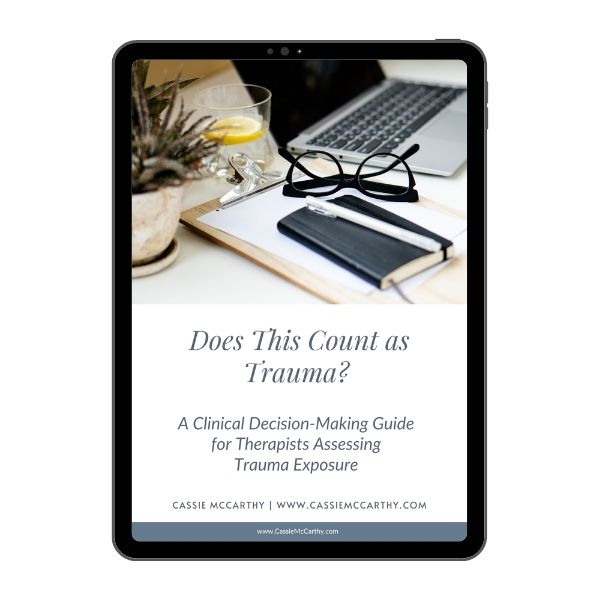
I offer a clinician resource called Does This Count As Trauma: A Clinical Decision Making Guide For Therapists Assessing Trauma Exposure. It is designed to help therapists define real or threatened harm with greater precision, especially in cases that do not involve overt violence.
The guide supports clearer assessment, more accurate formulation, and more confident treatment planning without forcing labels or escalating care prematurely.