

You may have asked yourself this question more times than you can count:
Why did I just do nothing?
You might replay the moment over and over, wondering why you did not fight back, speak up, leave, or stop what was happening. Maybe the question has slowly turned into something heavier. Maybe it now sounds like self blame.
“I should have done something.”
“I must have allowed it.”
“Maybe it was my fault.”
This question is one of the most painful and misunderstood experiences women carry after trauma. And it is not a sign of weakness. It is a sign that your nervous system did exactly what it was designed to do.
The Freeze Response Is A Survival Response, Not A Failure
Most people are familiar with fight or flight. Fewer people are taught about freeze, compliance, or appeasement.
These are not passive states. They are active survival responses that occur when the nervous system detects danger and determines that escape or resistance would increase risk.
Freeze is most likely to occur when:
- The threat feels inescapable
- There is a power imbalance
- Fighting back would escalate harm
- Leaving does not feel possible or safe
In these moments, the nervous system shifts into a state designed to preserve survival, not assert agency.
This is not something you choose.
It is something that happens to protect you.
What Freeze Looks Like From The Inside
Freeze does not always look dramatic.
It can look like:
- Feeling numb or disconnected
- Losing your voice or words
- Going still or quiet
- Automatically complying
- Appeasing to keep things from getting worse
- Doing what is asked even when it feels wrong
From the outside, this can be deeply confusing. From the inside, it often feels like your body moved ahead of your conscious mind.
That is because it did.
Nervous System Responses Under Constrained Choice
Freeze, compliance, and appeasement occur under constrained choice.
This means your nervous system assessed that:
- You did not have safe or viable options
- Saying no carried consequences
- Resistance might escalate danger
- Survival depended on minimizing threat, not confronting it
When people later ask, “Why didn’t you do something?”, they are asking the wrong question.
The more accurate question is:
What options did your nervous system believe were available at the time?
Often, the answer is very clear. There were none that felt safe.

Why Freeze Often Leads To Self Blame
Freeze responses are frequently followed by intense self blame. This is not random. It is psychological.
Self blame serves a specific function.
If you believe you were at fault, then it creates the illusion that you had control. And believing you had control can feel safer than facing the reality that you were powerless.
In this way, self blame is a trick of the brain. It is an attempt to regain a sense of agency after an experience that stripped it away.
But this comes at a cost.
Instead of placing responsibility where it belongs, self blame:
- Undermines self trust
- Lowers self esteem
- Keeps the nervous system in a state of vigilance
- Prevents healing
Freeze Was The Smartest Choice Available
This is the part that many women struggle to accept.
Freeze was not the wrong response.
Freeze was the best response available at the time.
Your nervous system made a rapid calculation based on:
- Context
- Power dynamics
- Risk of escalation
- Ability to escape
- Past learning about safety
And it chose the response most likely to preserve your survival.
That does not mean what happened was okay.
It means your body was doing its job.
When Freeze Gets Misunderstood As Consent Or Weakness
One of the most harmful myths surrounding freeze is the idea that stillness or compliance equals consent.
Clinically, this is false.
Consent requires choice.
Freeze occurs when choice is constrained or removed.
When someone freezes, complies, or appeases, it is because their nervous system has determined that resistance is unsafe. That response cannot be retroactively reframed as permission.
Understanding this distinction matters, not for labels, but for healing.
If you have ever wondered whether your response means what happened “counts,”
I created a client centered checklist to help women make sense of experiences without forcing conclusions or diagnoses.
Does This Count As Trauma?
A Checklist For Women Who Wonder If What They Went Through Was “Bad Enough” To Be Called Trauma
It is designed to support clarity, not self blame.

Freeze Does Not Mean PTSD And It Does Not Mean You Are Broken
Another important clarification is this.
Experiencing a freeze response does not automatically mean PTSD. Many people freeze during threatening situations and do not develop trauma related disorders.
What matters is not the presence of freeze alone, but how the experience shaped beliefs about safety, power, and self trust afterward.
This is why assessment matters.
Exposure is not diagnosis.
Response is not pathology.
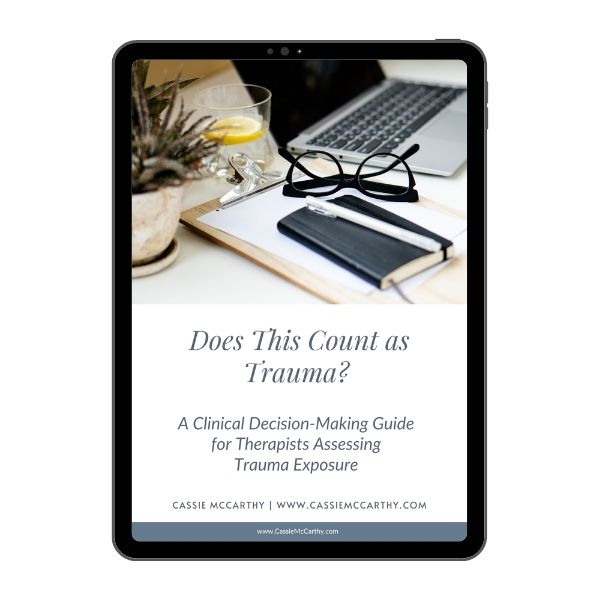
For clinicians navigating these questions with clients,
I created a structured decision making guide that supports accurate assessment of trauma exposure without over pathologizing.
Does This Count As Trauma?
A Clinical Decision Making Guide For Therapists Assessing Trauma Exposure
It focuses on actual versus threatened harm, contextual threat processing, and ethical pacing.
How Trauma Therapy Addresses Freeze And Self Blame
In my work, I use evidence based trauma therapy, particularly Cognitive Processing Therapy, to help clients understand how survival responses shaped their beliefs about themselves.
This work focuses on:
- Reducing self blame
- Restoring accurate responsibility
- Rebuilding trust in the nervous system
- Learning to live without constant vigilance
This is not about reliving what happened or forcing emotional expression. It is about helping the brain update outdated survival beliefs that no longer serve you.
There Is Nothing Wrong With You
If you froze, complied, or appeased, it does not mean you failed.
It means your nervous system recognized threat and acted to protect you.
Healing begins when you stop asking why you did nothing and start understanding what your body was doing to keep you alive.
Therapy Support
I work with women who have experienced sexual trauma, coercion, and relational harm using structured, evidence based trauma therapy.
If you live in Massachusetts, Illinois, Virginia, Vermont, or Florida, you can reach out to schedule a consultation to see whether this approach is the right fit.
You are not weak.
You are not broken.
Your body chose survival.
For Therapists & Clinicians:
Are you ready to offer this level of care? Take the Trauma-Focused Provider Readiness Self-Assessment in my toolkit to assess your readiness for TFC training.